
Author: Jim Sprouse, Co-founder of Ember Pro, BS in Environmental Studies from Allegheny College, Certified Wildfire Defense Specialist
Expert Review: Ryan Kresan, COO and Co-founder, Ember Pro
Reading Time: Approximately 12 minutes
Introduction
When a wildfire becomes a conflagration, the question is no longer whether fire crews are skilled or whether resources are available. The question becomes whether homes are prepared to survive on their own.
That is the central lesson of the Insurance Institute for Business and Home Safety 2025 LA Conflagrations Report, which analyzed the Palisades and Eaton Fires in Los Angeles County. These fires destroyed more than 16,000 structures and became among the most destructive in California history.
The report does not rely on speculation. It is built on field inspections, damage surveys, and forensic analysis of how homes ignited and how fire spread through neighborhoods.
The findings are clear. Homes did not fail randomly. They failed in predictable ways.
Just as important, the report confirms that many losses were preventable.
This companion article translates IBHS findings into practical protection strategies and explains how Ember Pro’s approach aligns directly with what the science proves works.
Editor’s note: Your insurance situation depends heavily on your property’s actual fire exposure. Our free risk assessment factors in official CAL FIRE data to show what your risk level actually is — useful context before talking to your carrier.
What the IBHS Report Makes Clear
The IBHS report reinforces several core truths about wildfire behavior in urban and suburban environments.
First, embers, not flame fronts, are the dominant cause of home ignition.
Second, the area closest to the home, especially the first five feet known as Zone 0, is the most critical ignition zone.
Third, partial mitigation is not enough. Homes survive when multiple vulnerabilities are addressed together.
Finally, during extreme wind driven events, firefighters cannot protect every structure. Homes must be able to resist ignition independently.
These findings are not new, but the scale of the LA fires and the density of destruction make them impossible to ignore.
Not sure which step to prioritize first? Our wildfire risk calculator shows your CAL FIRE zone and exposure level — so you know exactly where to start.
Ember Exposure Is the Primary Threat
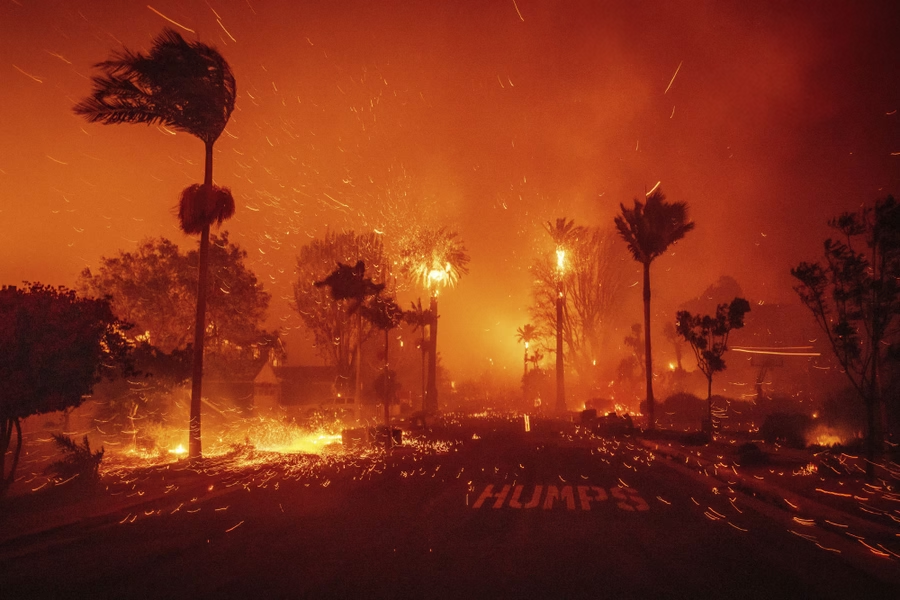
IBHS found that embers carried by Santa Ana winds ignited homes far ahead of the main fire front. Once embers entered neighborhoods, fire spread rapidly from structure to structure.
This confirms what wildfire science has shown for years. A home does not need to be surrounded by flames to be lost. It only needs one ember to find a receptive surface.
Ember Pro’s entire defense philosophy is built around this reality.
Wildfire defense must focus on:
- Reducing ember receptivity
- Treating ignition surfaces
- Interrupting ember accumulation zones
- Reinforcing the home ignition zone
This is why Ember Pro does not rely on water alone and does not depend on last minute suppression.
Zone 0 Is Where Homes Are Won or Lost
One of the most striking findings in the IBHS report involves Zone 0.
Homes with more than 25 percent combustible coverage within five feet of the structure experienced damage or destruction rates approaching 100 percent. This included mulch, vegetation, fencing, and even small decorative elements.
California law now recognizes Zone 0 as an ember resistant zone under AB 3074 for this exact reason.
Ember Pro solutions are designed to reinforce Zone 0 in two ways.
First, through education and assessment, identifying materials and features that create ignition pathways.
Second, through spray services and defense systems that treat ground cover, vegetation, and transition areas to reduce ignition potential when embers arrive.
Zone 0 is not landscaping. It is a fire interface.
Connective Fuels Drive Structure to Structure Loss
IBHS documented how fences, hedges, pergolas, and attached features repeatedly acted as conduits for fire.
Once one structure ignited, fire traveled along these connective fuels into neighboring homes, creating a cascading effect.
This is where individual home preparation intersects with community risk.
Ember Pro addresses this reality by:
- Identifying connective fuel pathways during assessments
- Treating perimeter vegetation and shared boundaries
- Supporting neighborhood and HOA scale protection strategies
- Reinforcing community immunity rather than isolated protection
Fire does not respect property lines. Defense strategies cannot stop at them either.
Home Hardening Must Be Comprehensive
The IBHS report confirms that having one or two fire resistant features is not enough.
Homes with multiple hardened components performed significantly better than those with partial upgrades. Failure often occurred at windows, vents, eaves, or attachment points.
This aligns directly with Ember Pro’s layered defense philosophy.
No single measure is relied upon. Instead, Ember Pro integrates:
- Home hardening awareness
- Ember resistant materials
- Zone 0 treatment
- Supplemental wildfire defense systems
- Ongoing maintenance strategies
A system only works when its weakest point is addressed.
Why Water Alone Is Not Enough
IBHS documented conditions where extreme winds limited firefighting effectiveness. Aircraft were grounded. Fire crews could not safely access neighborhoods. Structures were lost quickly.
This reality exposes a common misconception. Water alone is not a reliable wildfire defense strategy for homeowners.
Water evaporates rapidly under heat and wind. It requires constant pressure and availability, which cannot be assumed during major fires.
Ember Pro systems use fire retardants designed to adhere to surfaces, remain effective after drying, and resist degradation from sunlight and moderate precipitation.
This approach aligns with fire science, not wishful thinking.
Real World Performance Confirms the Data
In recent Los Angeles fire events, homes protected by retardant based wildfire defense systems showed dramatically higher survival rates compared to surrounding properties.
In documented survivability analyses, every system that successfully protected a structure relied on chemical retardants rather than water alone.
This mirrors IBHS conclusions. Ignition prevention works best when surfaces are treated in advance, before embers arrive and firefighting access is lost.
Curious about your property’s actual wildfire risk? Our free calculator shows your CAL FIRE zone, exposure level, and recommended next steps based on your address.
Get your free risk scoreWildfire Defense Is Also Financial Protection
The IBHS report focuses on physical loss, but its implications extend far beyond structures.
When a home burns, homeowners face:
- Years of displacement
- Rental inflation
- Escalating construction costs
- Insurance shortfalls
- Long term financial stress
Preventing structure loss avoids these cascading consequences entirely.
This is why Ember Pro views wildfire defense as both a safety strategy and a financial protection strategy.
Homes that do not burn do not enter the insurance system. They do not face rebuild delays. They do not experience the unfair math that follows wildfire loss.
Why Timing Matters
One of the clearest lessons from the IBHS report is that extreme fire behavior unfolds faster than response systems can react.
Homes must be prepared before a fire starts.
Ember Pro solutions are designed for proactive deployment, not last minute reaction. Spray services are applied in advance. Defense systems are installed and tested before fire season. Assessments identify vulnerabilities while there is still time to address them.
Once evacuation orders are issued, options disappear.
Aligning Science With Action
The IBHS report provides the science. Ember Pro provides a way to act on it.
This alignment is not accidental. It is the result of designing wildfire protection around how fires actually behave, not how people hope they will behave.
The report confirms that:
- Ember resistance matters most
- Zone 0 is critical
- Layered protection works
- Community scale approaches reduce loss
- Homes must defend themselves
These are the same principles that guide Ember Pro’s approach across California.
Frequently Asked Questions
Does the IBHS report support ember focused defense?
Yes. Ember exposure was identified as the primary ignition source.
Why is Zone 0 emphasized so heavily?
Because it is the most common ignition area and the easiest to control.
Can one upgrade protect a home?
No. IBHS shows that multiple measures are required.
Why are fences such a problem?
They act as connective fuels that bring fire directly to homes.
Does firefighting always save homes?
No. Extreme wind events often limit access and effectiveness.
Why use retardants instead of water?
Retardants remain effective longer and resist evaporation.
Do these findings apply outside LA?
Yes. The fire behavior observed applies statewide.
Is wildfire defense only for high risk zones?
No. Embers travel far beyond mapped zones.
Can neighborhoods work together?
Yes. Community scale protection improves outcomes.
What is the biggest lesson from IBHS?
Homes that resist ignition survive.
References
- Insurance Institute for Business and Home Safety — The 2025 LA Conflagrations
- California Department of Forestry and Fire Protection — Defensible Space and Zone 0 Guidance
- National Fire Protection Association — Home Ignition Zone Research
Call to Action
The science is no longer theoretical. It is documented, measured, and repeatable.
Wildfire defense works when it aligns with how fires actually behave. The IBHS report confirms that ignition resistance, not reaction, is what saves homes.
Protecting your home before the next fire is not optional. It is the only reliable way to avoid loss, displacement, and the long term consequences that follow.
Schedule a free wildfire defense consultation to learn how Ember Pro can help protect your home.