
Curious about your property’s actual wildfire risk? Our free calculator shows your CAL FIRE zone, exposure level, and recommended next steps based on your address.
Get your free risk scoreIntroduction
The fire did not stop at the canyon.
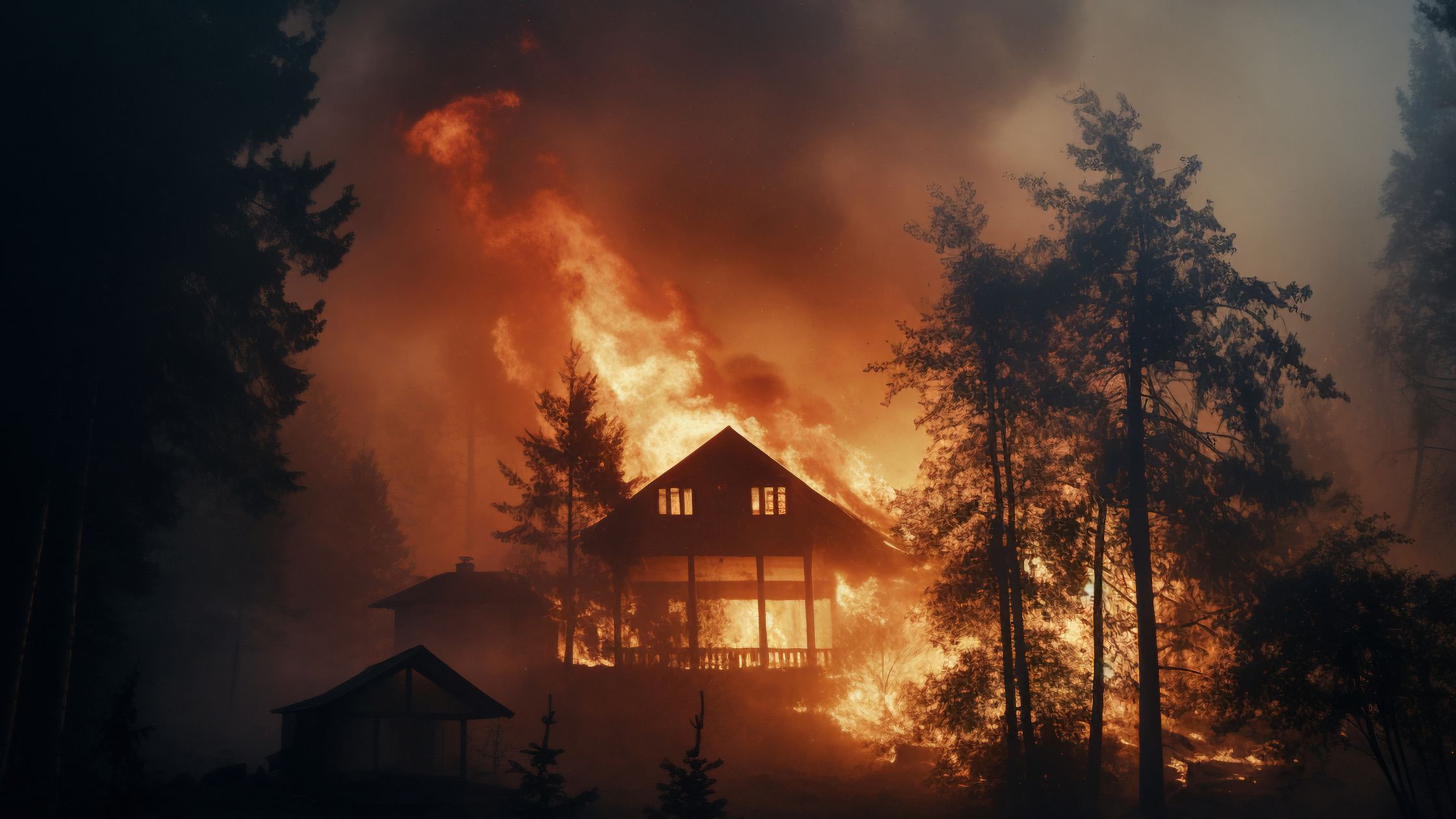
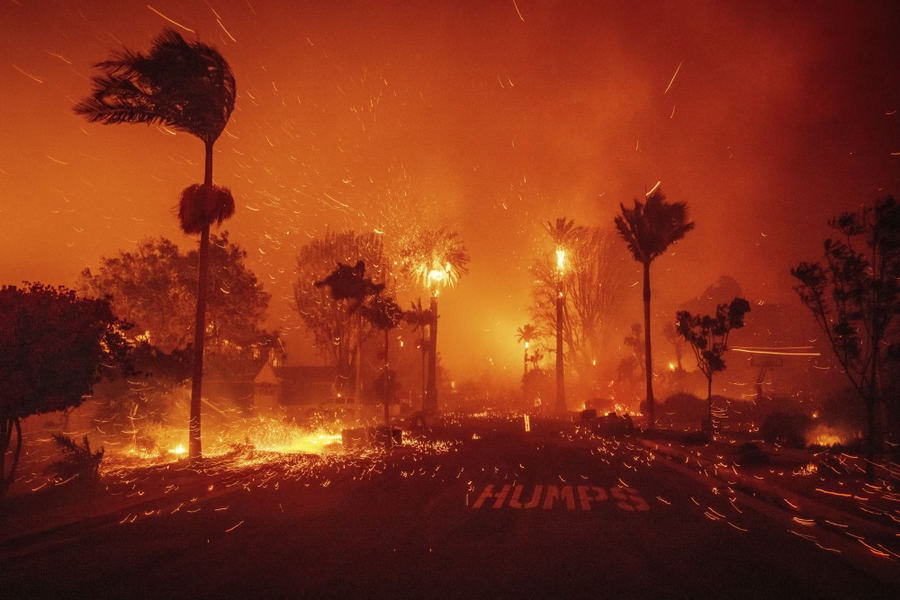
It crossed roads, jumped driveways, ignited fences, and moved house to house through dense Los Angeles neighborhoods faster than firefighters could respond. For many residents, the fire was not a distant wall of flames — it arrived as embers raining down on homes that were never designed to withstand them.
This is the new wildfire reality in California.
A recent commentary published by CalMatters, written by Chad Hanson, makes this point with clarity and urgency. In the article “LA firestorms show what it would really take to make California fire safe”, the author argues that California continues to talk about fire safety while failing to implement it at the scale and consistency required.
You can read the original article here: CalMatters: LA firestorms show what it would really take to make California fire safe
We agree with the author.
This blog builds on that argument, expands on the fire science behind it, and explains why fire safe California must be treated as a system, not a slogan.
Editor’s note: Your insurance situation depends heavily on your property’s actual fire exposure. Our free risk assessment factors in official CAL FIRE data to show what your risk level actually is — useful context before talking to your carrier.
Wildfires Are No Longer Just Wildland Events
One of the most important points raised in the CalMatters commentary is that recent fires in Los Angeles and across the state are not behaving like traditional wildland fires.
They are built environment fires.
Once embers enter a neighborhood, homes, landscaping, fences, decks, and accessory structures become fuel. Fire moves through communities, not around them. At that point, the distinction between wildland and urban fire disappears.
Fire science and post-fire investigations consistently show that structure-to-structure ignition, driven by embers and radiant heat, is now the dominant loss mechanism.
Fire Safe California Fails When It Is Fragmented
The CalMatters article highlights a familiar pattern.
Some homes are hardened. Some residents clear defensible space. Some jurisdictions enforce codes.
But wildfire exploits inconsistency.
Fire does not care which home complied and which did not. It moves through the weakest link. This is why fire safety cannot be optional, patchwork, or dependent on individual effort alone.
Fire safe California must be implemented at the community level, not just the parcel level. See how one HOA earned insurance credits through coordinated ember assessments.
Density Without Ignition Resistance Is a Risk Multiplier
The commentary also makes clear that land use decisions are fire decisions.
As communities become denser, spacing between structures shrinks. This increases radiant heat exposure, ember transfer, and the likelihood that one burning structure ignites another.
Fire science does not say dense communities cannot exist in wildfire-prone areas. It says they must be designed differently.
Without ignition-resistant materials, connective fuel management, and consistent standards, density accelerates loss.
Suppression Cannot Be the Primary Plan
Another theme reinforced by the CalMatters article is the continued reliance on firefighting as the solution.
During extreme wind events, suppression fails as a dependable variable. Aircraft are grounded. Crews cannot access neighborhoods. Water pressure drops.
This is not a failure of firefighters. It is physics.
Fire safe communities must be designed to survive without immediate intervention — which means wildfire defense systems and ignition resistance matter more than response. Learn more about how retardants and spray services support layered defense.
Not sure which step to prioritize first? Our wildfire risk calculator shows your CAL FIRE zone and exposure level — so you know exactly where to start.
Individual Effort Is Undermined Without Community Action
The author also touches on an uncomfortable truth for homeowners.
You can do everything right and still lose your home if the surrounding neighborhood remains vulnerable. Avoid these common wildfire risk assessment mistakes that leave homes exposed.
Wildfire risk is shared risk.
This is why HOAs, cities, and counties must adopt consistent wildfire standards. Community immunity matters as much as individual preparation.
Codes Help, But They Are Not the Finish Line
California has improved building standards through Chapter 7A, CWUIC, and defensible space requirements. These measures save homes, but the CalMatters article makes clear they are often treated as the endpoint rather than the baseline.
Many of the hardest-hit neighborhoods were built long before modern wildfire codes existed. Retrofitting these areas is difficult, but ignoring them guarantees repeat losses. Understand Zone 0 and AB 3074 compliance requirements for existing properties.
Fire safe California requires addressing both new and existing communities.
Where Ember Pro’s Work Fits
The solutions discussed in the CalMatters commentary align closely with how wildfire professionals approach risk reduction.
At Ember Pro, our work focuses on ignition prevention, layered defense, and neighborhood-scale resilience. Systems, treatments, and planning are designed to function when firefighters cannot be present and when wind-driven ember exposure dominates. See how this works in practice: Ember Assessment to Spray and Defense Upgrade case study.
These measures do not replace policy or planning. They support them by reducing the likelihood that one structure ignites the next.
Fire Safe California Requires Follow-Through
The CalMatters article is not about assigning blame. It is about follow-through.
California knows how wildfire spreads. We know what works. What is missing is consistent implementation.
Fire safe California will not come from slogans, press conferences, or rebuilding alone. It will come from designing communities that resist ignition before the fire arrives.
Frequently Asked Questions
What does fire safe California really mean?
It means designing homes and communities to resist ember ignition and structure-to-structure fire spread.
Are wildfires now urban fires?
In many cases, yes. Once fire enters neighborhoods, it behaves like an urban conflagration.
Why do embers matter so much?
Most homes ignite from embers, not direct flame contact.
Is defensible space enough?
No. Defensible space must be paired with home hardening and community-level action.
Can firefighters always protect homes?
No. Wind-driven fires often prevent effective suppression.
Do building codes solve wildfire risk?
Codes help, but they are a baseline, not a guarantee.
Why does density increase risk?
Tight spacing increases radiant heat and ember transfer between structures.
What is community immunity?
It is when enough homes reduce ignition risk so fire cannot easily spread through a neighborhood.
Does this apply only to wildfire zones?
No. Recent fires have burned well beyond mapped hazard areas.
What is the biggest takeaway?
Fire safe California requires systems, not slogans.
References
- CalMatters — LA firestorms show what it would really take to make California fire safe
- National Fire Protection Association — Wildfire Ignition Prevention and Community Risk Reduction
- Insurance Institute for Business and Home Safety — Structure Ignition and Ember Exposure Research
- California Department of Forestry and Fire Protection — Defensible Space and Community Wildfire Preparedness
Take Action
Wildfire risk in California is not theoretical. It is here.
The question is not whether another firestorm will occur, but whether communities will be prepared when it does.
Fire safe California starts with treating wildfire as a systems problem — and acting accordingly.