

California homeowners in Los Angeles County and San Diego County face increasingly stringent home hardening requirements to mitigate wildfire risk. While both counties operate under California’s statewide Chapter 7A standards, each has developed unique local ordinances that create different compliance pathways and timelines. Understanding these distinctions is crucial for property owners who want to meet requirements, protect their homes, and potentially qualify for insurance premium reductions.
Curious about your property’s actual wildfire risk? Our free calculator shows your CAL FIRE zone, exposure level, and recommended next steps based on your address.
Get your free risk scoreCalifornia’s Statewide Foundation: Chapter 7A
Before diving into county-specific requirements, it’s essential to understand the baseline. California’s Chapter 7A of the California Building Standards Code establishes the foundation for all wildfire-resistant construction. This chapter mandates specific standards for materials, defensible space, roof construction, vents, and deck construction in Wildland-Urban Interface (WUI) zones.
Chapter 7A covers:
- Class A fire-rated roofing materials
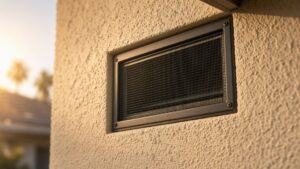
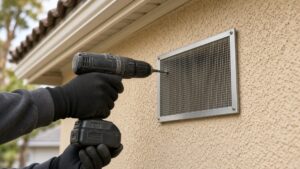
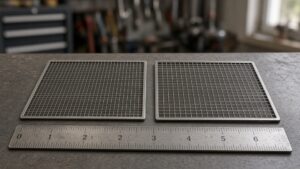
- 1/8-inch metal mesh screening for vents and openings
- Ember-resistant deck construction
- Vegetation management within 100 feet of homes (or property line)
- Non-combustible gutters and gutter guards
Both LA County and San Diego County build upon these state standards with local amendments and enhanced requirements. This creates a hierarchical system: homeowners must comply with Chapter 7A at minimum, plus any applicable county and municipal ordinances.
Editor’s note: Your insurance situation depends heavily on your property’s actual fire exposure. Our free risk assessment factors in official CAL FIRE data to show what your risk level actually is — useful context before talking to your carrier.
LA County Home Hardening Requirements
The LA County Wildfire Protection and Mitigation Ordinance
LA County has adopted several layers of home hardening requirements, primarily through the Wildfire Protection and Mitigation Ordinance. In high-risk WUI zones, LA County requires:
- Roof Compliance: Class A fire-rated roofing materials. LA County does not allow composite shingles that do not meet Class A standards.
- Defensible Space: Properties must maintain defensible space requirements extending up to 100 feet from the structure. This includes regular trimming of trees, removal of dead vegetation, and clearance of leaves and needles from gutters.
- Exterior Walls: Non-combustible cladding materials are required on exposed exterior surfaces. This means vinyl siding is not compliant.
- Attic Vents: Zone Zero hardening standards requires enclosed attic vents with 1/8-inch metal mesh screening to prevent ember infiltration.
- Windows: Class A fire-rated windows (dual-pane tempered or fire-retardant materials approved for California) in high-risk zones.
LA County Enforcement and Timeline
LA County’s approach emphasizes retrofit compliance for existing structures. The county has established phased compliance deadlines:
- Immediate Priority (2023-2024): Roofing and gutters in high-risk zones
- Phase 2 (2024-2025): Exterior walls and deck construction
- Phase 3 (2025-2026): Windows, vents, and remaining structural elements
Properties in LA County’s Local Responsibility Areas (LRA) that are not in Cal Fire’s responsibility zones must comply with LA County’s Municipal Code Title 7 requirements. Enforcement typically occurs during property transfers, permit applications, or following community notification of non-compliance.
LA County Inspection Standards
LA County conducts home hardening inspections through:
- County Fire Department evaluation
- Local building and safety divisions
- Third-party certified inspectors (for insurance-related assessments)
Inspections verify compliance with Class A roofing, defensible space clearance, vent screening, and exterior material standards. Homeowners receive detailed reports with specific remediation timelines.
San Diego County Home Hardening Requirements
San Diego County’s Approach: Enhanced Chapter 7A
San Diego County has taken a more prescriptive approach than LA County by more tightly integrating local requirements with Chapter 7A standards. San Diego County’s Consolidated Fire Code (which adopts and enhances the California Fire Code) mandates:
- Roof Requirements: Class A fire-rated materials, with San Diego County also requiring proper installation documentation and manufacturer certification.
- Defensible Space: 100-foot perimeter with specific vegetation management standards. San Diego County’s ordinance includes detailed provisions for tree species, spacing requirements, and pruning standards.
- Deck Construction: Non-combustible deck materials (no wood decks permitted in high-risk WUI zones). This is more stringent than statewide Chapter 7A.
- Exterior Materials: Non-combustible or fire-retardant-treated materials for all exposed structural elements.
- Access Roads: San Diego County also enforces minimum road width requirements (20 feet minimum for two-way access) to support emergency vehicle response.
San Diego County Compliance Timeline
San Diego County’s timeline is more accelerated than LA County:
- 2024-2025: Roofing, gutters, and defensible space clearance
- 2025-2026: Deck reconstruction and exterior cladding upgrades
- 2026+: Remaining structural modifications (windows, vents, access improvements)
San Diego County is more aggressive in enforcement, particularly following fire seasons with significant damage. The county has increased inspections in high-risk communities like Alpine, Ramona, and Julian.
San Diego County Inspection Process
San Diego County Fire Authority and local building departments conduct:
- Annual or bi-annual inspections in Very High Fire Hazard Severity Zones (VHFHSZ)
- Photo documentation of compliance status
- Notification letters with specific remediation requirements
- Follow-up inspections within 60 days of remediation notice
Properties found non-compliant receive abatement notices. If compliance deadlines are missed, San Diego County can place liens on properties or impose penalties.
Comparative Analysis: LA County vs San Diego County
| Requirement | LA County | San Diego County |
|---|---|---|
| Roof Standard | Class A fire-rated | Class A fire-rated with installation documentation |
| Deck Construction | Non-combustible (high-risk zones preferred) | Non-combustible (mandatory in VHFHSZ) |
| Defensible Space | 100 feet with annual maintenance | 100 feet with detailed species/spacing standards |
| Exterior Cladding | Non-combustible required | Non-combustible or fire-retardant-treated required |
| Vent Screening | 1/8-inch metal mesh (Zone Zero) | 1/8-inch metal mesh with sealed installations |
| Windows | Class A fire-rated in high-risk zones | Class A fire-rated in VHFHSZ |
| Compliance Deadline | Phased through 2026 | Accelerated through 2025-2026 |
| Enforcement | On-demand and transfer-related | Annual/bi-annual inspections in VHFHSZ |
These are general costs. Your actual investment depends on your property’s fire zone, exposure level, and available grants or rebates.
Check my risk scoreWUI Zones and Risk Assessment
Both counties rely on California’s Fire Hazard Severity Zone (FHSZ) mapping to determine which properties must comply with enhanced standards. Properties in:
- High Fire Hazard Severity Zones (HFHSZ) have accelerated timelines and more rigorous enforcement
- Very High Fire Hazard Severity Zones (VHFHSZ) face the most stringent requirements and shortest compliance windows
Both LA County and San Diego County have interactive online maps showing FHSZ designations. Homeowners should verify their property’s designation before planning renovation budgets, as VHFHSZ properties require more extensive (and expensive) modifications.
Not sure which step to prioritize first? Our wildfire risk calculator shows your CAL FIRE zone and exposure level — so you know exactly where to start.
Cost Comparison: Home Hardening Investments
The cost differential between LA County and San Diego County compliance varies based on property-specific factors:
- Roof Replacement: $15,000-$35,000 (both counties same cost)
- Defensible Space Clearing: $5,000-$15,000 annually in San Diego County (more detailed standards); $3,000-$10,000 in LA County
- Deck Reconstruction: $20,000-$60,000 (both counties, though San Diego County mandatory status increases uptake)
- Exterior Cladding: $30,000-$100,000+ (both counties equivalent, depending on home size)
- Windows and Doors: $8,000-$25,000 per property (both counties similar)
San Diego County properties typically invest in compliance earlier, spreading costs over 2024-2025. LA County properties have more flexibility in phasing investments through 2026.
How insurance savings with home hardening Can Offset Costs
Both counties see insurance companies offering premium reductions for verified home hardening improvements. Carriers providing premium reductions in both regions include:
- State Farm (up to 15% discount in CA)
- Allstate (up to 20% discount with verified hardening)
- Progressive (15% discount for Class A roofing + home defense systems)
Homeowners should request insurance quotes after completing compliance work, as premium savings can recover 10-30% of total hardening investment within 5 years.
Ember Pro’s Role in LA County and San Diego County Compliance
Ember Pro USA specializes in helping homeowners navigate both county systems:
- LA County: We provide phased compliance planning aligned with the county’s 2023-2026 timeline, allowing property owners to prioritize investments and budget effectively.
- San Diego County: We accelerate compliance requirements through our detailed exterior suppression systems assessments and streamlined inspection preparation.
Our services include:
- Property-specific risk assessments and FHSZ verification
- Detailed home hardening audit reports
- Vendor coordination and project management
- Insurance verification and premium reduction documentation
- Post-completion inspection support
FAQ: Home Hardening in LA County and San Diego County
Q: Do I need to comply if my property is in both counties (border properties)?
A: Properties must comply with the county(ies) where they are located. County boundary lines are clearly marked on fire hazard maps. If your home straddles a boundary, the more stringent requirements apply to the portion of land in that county.
Q: Can I apply for a hardening grant or rebate in LA or San Diego County?
A: Limited grant programs exist through CAL FIRE’s Wildfire Prevention Grants program. Additionally, some insurance carriers and utilities offer rebate programs. Ember Pro can help identify available incentive programs for your specific location.
Q: What happens if I don’t comply by the deadline?
A: LA County: Potential denial of property transfers and insurance issues. San Diego County: Property liens, fines, and abatement action by the county. Both outcomes are avoidable with proactive compliance.
Q: Are there differences in HOA rules vs. county requirements?
A: Yes. Homeowners Associations in both counties may have additional or conflicting rules. County California wildfire laws typically supersede HOA provisions when more stringent, but homeowners should verify this with their HOA.
Q: How often must I repeat defensible space work?
A: Annual maintenance is required in both counties. San Diego County often conducts follow-up inspections annually in VHFHSZ areas, so consistent maintenance is documented.
Next Steps: Determining Your Compliance Pathway
Homeowners in LA County and San Diego County should:
- Verify your property’s Fire Hazard Severity Zone designation (use county interactive maps)
- Request a home hardening assessment from a qualified professional (Ember Pro offers this service)
- Develop a phased compliance plan aligned with your county’s timeline
- Begin with roofing and defensible space—the highest-impact and often most urgent improvements
- Document all work for insurance and county records
- Plan for annual wildfire preparedness maintenance as part of your ongoing home protection strategy
Conclusion: Regional Compliance for California Homeowners
Los Angeles County and San Diego County represent two different approaches to home hardening compliance requirements. LA County’s phased approach allows flexibility but requires proactive planning. San Diego County’s accelerated timeline demands faster action but provides clear, documented standards.
Regardless of which county you call home, home hardening is now a non-negotiable investment for California property owners in WUI zones. Both counties’ ordinances will continue to evolve as Cal Fire data informs more stringent standards. Starting now—whether in 2026 or 2025—positions you ahead of future regulation increases and wildfire mitigation insurance improvements.
Ember Pro USA is here to guide you through both county systems, ensuring your home meets all requirements, qualifies for insurance discounts, and achieves genuine wildfire resilience. Contact us today for a free property assessment and compliance requirements roadmap tailored to your location.