
Neighborhood-Scale Fire Protection
Author: Jim Sprouse, Co-founder of Ember Pro, BS in Environmental Studies from Allegheny College, Certified Wildfire Defense Specialist
Expert Review: Ryan Kresan, COO and Co-founder, Ember Pro
Breadcrumb: Insights, Community Wildfire Defense, Wildfire Defense Systems, California Wildfires
Introduction
Wildfire defense has traditionally been framed as an individual responsibility. One homeowner hardens their home. Another clears defensible space. Someone installs a wildfire sprinkler system and hopes it is enough.
But wildfires do not respect property lines.
In California, especially across San Diego, Los Angeles, Santa Barbara, and inland foothill communities, the next evolution of wildfire protection is becoming clear. Neighborhood-scale fire protection, built around coordinated spray services and shared wildfire defense systems, is emerging as the most effective way to reduce catastrophic losses.
This concept is best described as community immunity.
Just as herd immunity reduces the spread of disease, community immunity reduces wildfire spread by limiting the number of structures that can ignite, transmit embers, or radiate heat to neighboring properties.
This article explores how neighborhood-scale spray services work, why they are more effective than isolated defenses, and why community immunity represents the future of wildfire defense in California.
What Is Community Immunity in Wildfire Defense
Community immunity refers to a condition where enough structures in a defined area are protected that wildfire spread is disrupted or stopped altogether.
Instead of relying on one defended home surrounded by vulnerable neighbors, community immunity creates:
- Fewer ignition points
- Less structure-to-structure fire spread
- Lower ember density
- Reduced radiant heat buildup
In practical terms, when a wildfire encounters a neighborhood with coordinated protection, it behaves differently. Fires slow, spot fires fail to establish, and embers are less likely to cascade into full structural ignition.
This is not theory. It is supported by real-world wildfire outcomes.
Why Individual Defense Alone Is Not Enough
A single defended home surrounded by unprotected structures still faces risk.
Common failure scenarios include:
- A neighboring home ignites and radiates heat
- Burning debris lands on a defended structure after protection has worn off
- Fire jumps from fences, sheds, or vegetation between properties
This is why even well-hardened homes can be lost in dense neighborhoods.
Community immunity addresses this gap by reducing the fuel load at the neighborhood scale, not just the parcel level.
The Structure-to-Structure Fire Problem
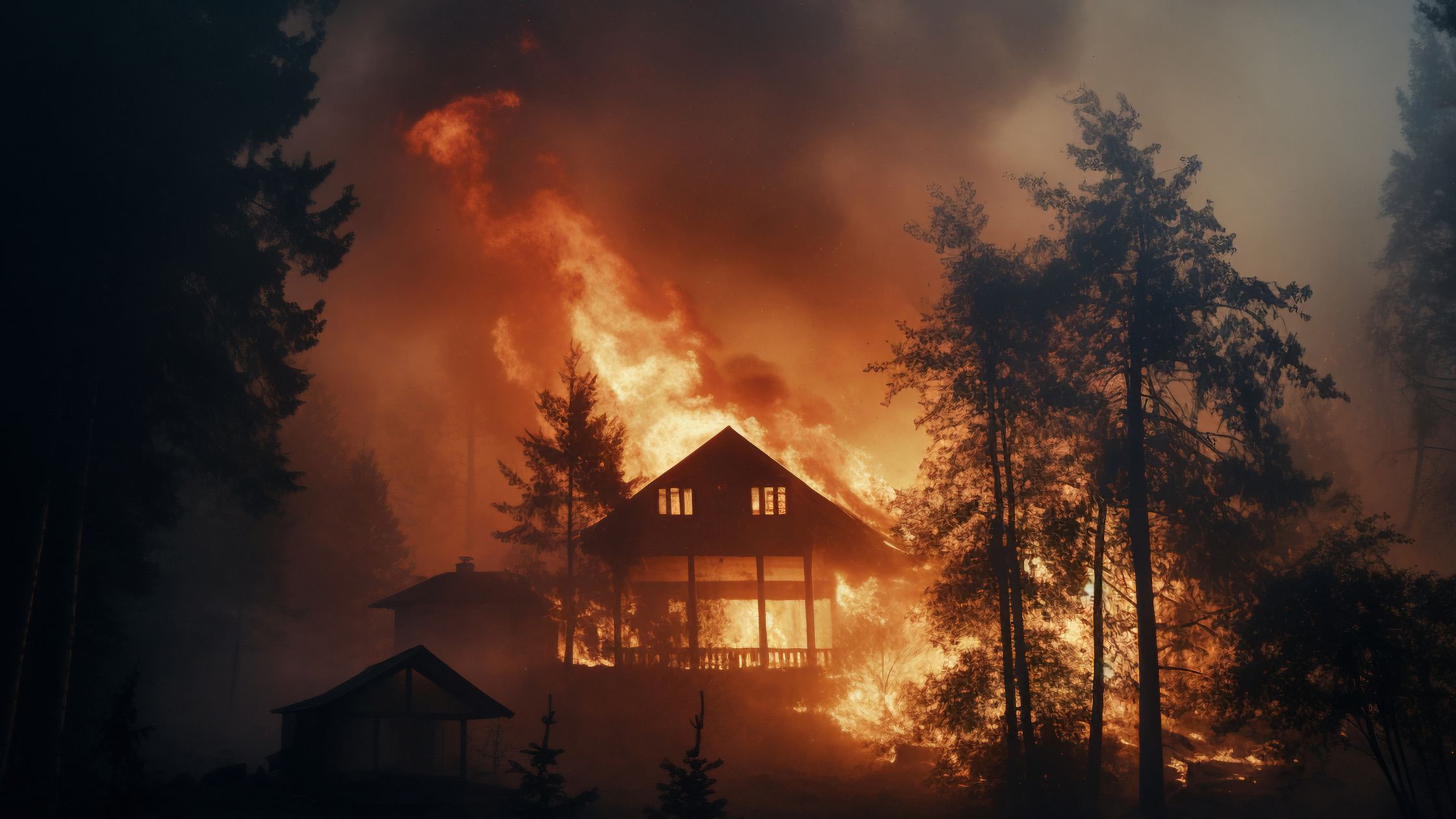
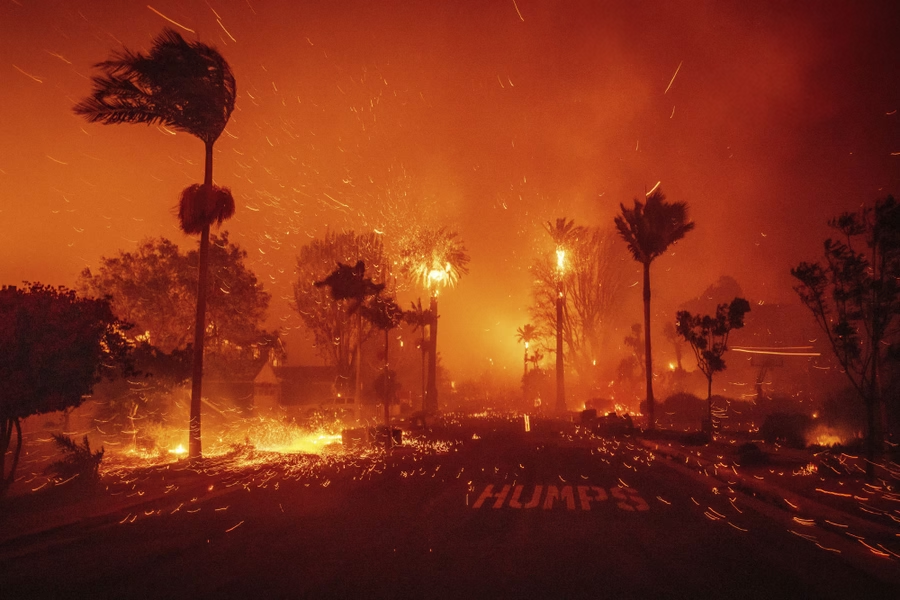
In many California wildfires, especially in suburban and exurban areas, homes burn other homes.
Once a structure ignites, it becomes a massive fuel source:
- Roofing materials
- Siding, decks, and fences
- Furniture and contents
- Vehicles and outbuildings
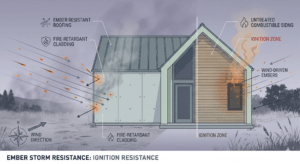
This generates intense radiant heat and showers of embers that overwhelm nearby properties.
Stopping this chain reaction is the single most effective way to prevent neighborhood-wide loss.
Neighborhood-scale wildfire defense systems are designed specifically to interrupt this process.
How Neighborhood Scale Spray Services Work
Neighborhood-scale protection builds on the same principles as individual wildfire defense systems, but expands them across multiple properties in a coordinated way.
Core Components
A neighborhood-scale spray service typically includes:
- Retardant-based wildfire defense systems installed on multiple homes
- Coordinated activation protocols
- Shared risk assessments and wind modeling
- Coverage of common areas, access roads, and perimeter zones
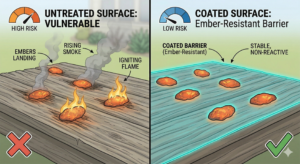
- Emphasis on Zone 0 and five-foot protection around every structure
Each home still has its own system, but the systems function as a network, not isolated units.
Retardant as the Backbone of Community Immunity
Retardant is essential at the neighborhood level for one reason: duration.
Water-based systems require constant flow. Retardant-based systems continue to provide protection after drying, which allows:
- Staggered or early activation
- Protection during extended ember storms
- Coverage even if power or communications are disrupted
When multiple homes deploy retardant in advance of a fire, the entire neighborhood becomes less receptive to ignition.
Why Timing Matters at Scale
Wildfire response at the neighborhood level is often delayed. Fire crews may be hours away. Aircraft may not fly due to wind or smoke.
Community spray services can be activated before the fire arrives, creating a treated zone that the fire must move through.
This proactive approach is critical. Once structures are actively burning, suppression options are limited.
Community Immunity and AB 3074
California is already moving toward a community-based model through regulation.
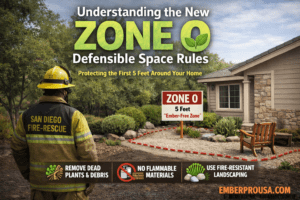
AB 3074 and the creation of Zone 0, the five feet around every structure, reflects an understanding that ignition prevention must happen at the smallest and largest scales simultaneously.
When an entire neighborhood complies with Zone 0 requirements and reinforces them with coordinated spray services:
- Ember ignition drops dramatically
- Fire spread slows
- Insurance risk improves
- Firefighter safety increases
Community immunity turns regulatory compliance into real-world resilience.
Case Examples, Why Groups of Protected Homes Survive
Across multiple wildfire events, the same pattern appears:
- Clusters of protected homes survive
- Isolated homes, even if hardened, face higher risk
- Fire behavior changes when ignition opportunities are limited
During recent fires in Los Angeles County, neighborhoods with multiple wildfire defense systems installed saw

than adjacent areas without coordinated protection.
The lesson is clear. Protection works best in groups.
Environmental Benefits of Community Immunity
Community-scale protection delivers benefits beyond property survival.
Reduced Toxic Emissions
Every structure that does not burn prevents:
- Release of plastics and synthetic materials
- Heavy metal contamination
- Massive particulate pollution
Neighborhood-scale protection prevents these emissions at scale.
Reduced Aerial Retardant Use
When homes are protected locally, firefighters rely less on large aerial retardant drops, reducing runoff into waterways and coastal ecosystems.
Faster Community Recovery
Communities that retain most of their housing stock recover faster, with less debris removal, less displacement, and lower public cost.
Commercial and Multi-Family Applications
Community immunity is not limited to single-family neighborhoods.
It applies equally to:
- Apartment complexes
- Townhome developments
- Mixed-use communities
- Rural commercial corridors
Commercial properties often share walls, parking areas, and access points, making coordinated defense even more critical.
Neighborhood-scale spray services allow property managers to protect entire complexes with a unified strategy.
Insurance, Risk, and Community Protection
Insurance carriers increasingly evaluate risk at the community level, not just the individual parcel.
Factors include:
- Density of combustible structures
- Defensible space compliance
- Fire history
- Mitigation participation rates
Neighborhoods that adopt coordinated wildfire defense measures may:
- Retain insurance availability longer
- Experience fewer non-renewals
- Demonstrate lower loss ratios
Community immunity aligns homeowner, insurer, and public safety interests.
Why Ember Pro Is Built for Neighborhood Scale Protection
Ember Pro systems are designed to scale without proportional cost increases.
Key advantages include:
- Modular design
- No roof penetrations unless required
- No trenching unless necessary
- Retardant-first strategy
- Remote and coordinated activation
This makes Ember Pro uniquely suited for neighborhood deployment, HOA partnerships, and community-led mitigation efforts.
Overcoming Common Barriers
Cost Sharing
When multiple homeowners participate, costs can be shared or reduced through:
- Bulk installation efficiencies
- Shared planning and assessment
- HOA coordination
The cost per home often decreases as participation increases.
Education and Buy-In
Community immunity requires education. When homeowners understand that their neighbor’s home affects their own risk, participation increases naturally.
10 Frequently Asked Questions
- What is community immunity in wildfire defense?
It is the reduction of wildfire spread through coordinated protection of multiple structures. - Does every home need a system?
No, but higher participation dramatically improves effectiveness. - Is this compliant with AB 3074?
Yes. It supports Zone 0 and defensible space requirements. - Can HOAs implement this?
Yes. HOAs are ideal candidates for neighborhood-scale spray services. - Does this replace fire departments?
No. It supports firefighters by reducing ignition and spread. - Is water used at the neighborhood level?
Retardant is more effective for sustained protection. - How early are systems activated?
Often before evacuation, when a credible fire threat exists. - Does this work in high winds?
Yes, systems are designed with wind direction and pressure in mind. - Are commercial neighborhoods eligible
Yes. Commercial and mixed-use areas benefit greatly. - How do communities get started
With a shared wildfire risk assessment and system design.
Final Thoughts
Wildfires are a community problem, not an individual one.
As California continues to face longer fire seasons and greater losses, the future of wildfire defense will be defined by collective action, not isolated effort.
Neighborhood-scale spray services and community immunity represent a shift from reactive response to proactive resilience. They reduce loss, protect the environment, and keep communities intact.
The neighborhoods that adapt first will be the ones that remain standing.