
The Hidden Environmental Toll of Homes Lost to Wildfire — And How Defense Systems Prevent It
Author: Jim Sprouse, Co-founder of Ember Pro, BS in Environmental Studies, Allegheny College. NFPA Cert. Wildfire Mitigation Specialist
Expert Review: Ryan Kresan, COO and Co-founder, Ember Pro
Introduction

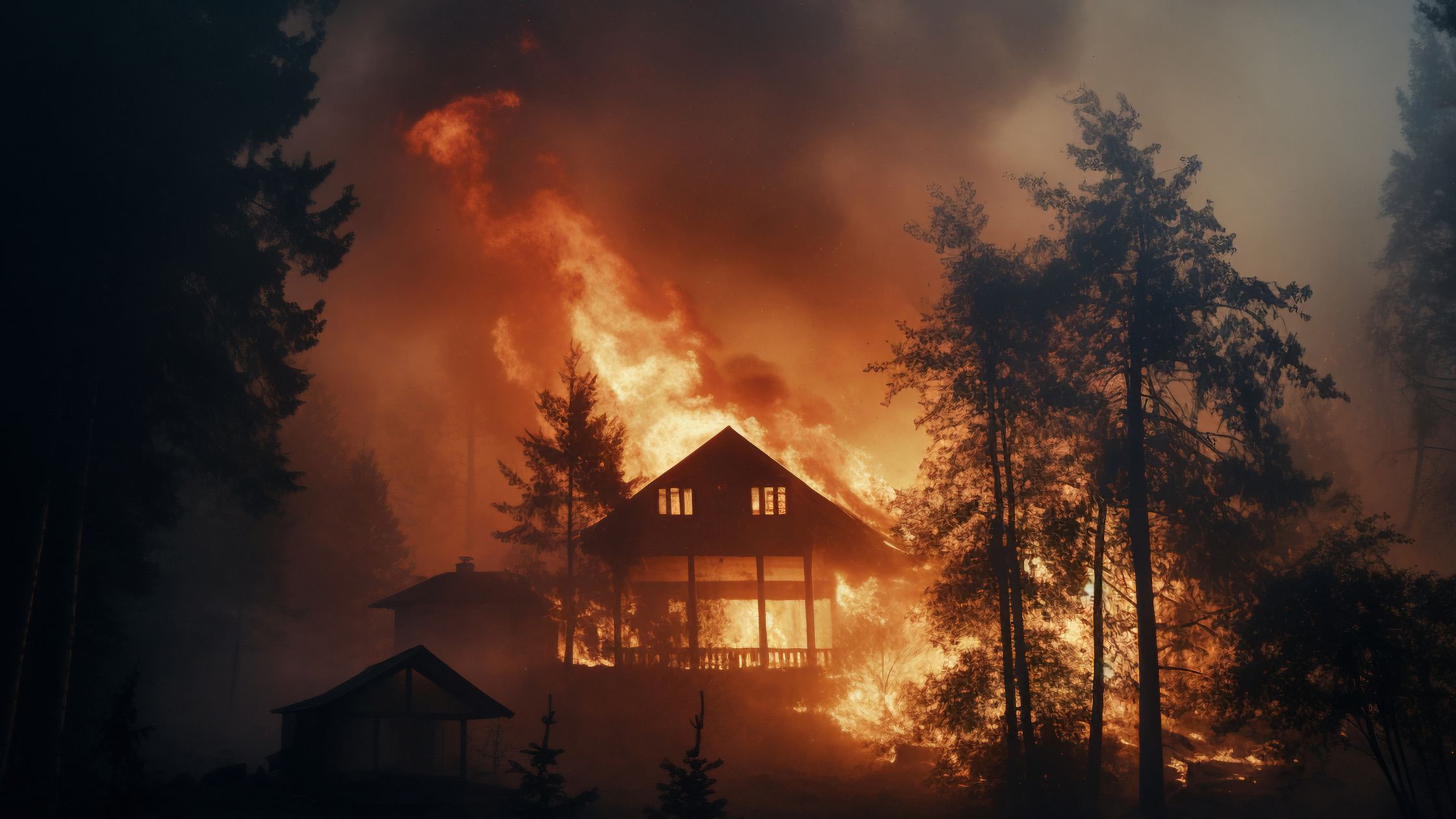
When a home burns in a wildfire, the loss extends far beyond walls and memories. It becomes a toxic factory. What was once wood, plastic, insulation, and furniture transforms into airborne poisons, contaminated runoff, and ecological disruption. Multiply that by hundreds or thousands of homes, and the environmental cost becomes staggering.
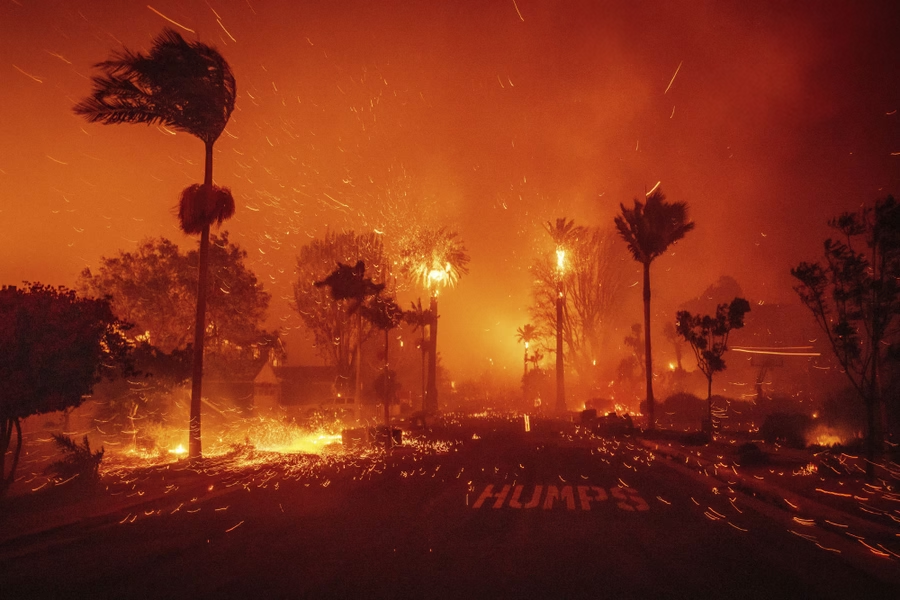
In California, where wind-driven wildfires can consume entire neighborhoods in hours, wildfire defense systems are no longer just about saving property. They are an essential part of environmental protection and resilience.
Table of Contents
- The Environmental Fallout of a Burning Home
- What Happens When Commercial Buildings Burn
- The Hidden Cost of Phos-Chek and Aerial Retardants
- Kelp Forests and the Ocean Food Web at Risk
- Wildfire Defense Systems: The First Line of Environmental Defense
- Why Every Property Type Is at Risk
- Frequently Asked Questions
- Final Thoughts
- References
The Environmental Fallout of a Burning Home
Let’s consider the environmental impact of a 3,000-square-foot California home lost to fire. This is a fairly standard size in places like San Diego, Los Angeles, and Santa Barbara counties.
Building Materials Released Into the Environment
A single home of this size includes:
- Framing: 15,000–20,000 board feet of lumber
- Roofing: Asphalt composite or clay tile (hydrocarbons or ceramic particulates)
- Drywall: Over 5 tons of gypsum (with potential silica dust release)
- Insulation: Fiberglass or polyurethane foam, both of which release cyanide and isocyanates when burned
- Piping/Wiring: PVC and plastic conduit (releases dioxins and furans)
- Paints, sealants, caulking: Heavy in volatile organic compounds (VOCs)
Contents & Furnishings
A fully furnished 3,000 sq ft home typically contains:
- 3–5 beds and mattresses: Polyurethane foam, flame retardants
- 2–3 sofas: Polyester fabric and foam
- Appliances: Plastics, refrigerants, circuit boards
- Electronics: Contain lead, cadmium, lithium
- Plastics: Toys, containers, storage bins
- Cleaning products: Bleach, ammonia, solvents
According to EPA research, a single house fire can release up to 10 tons of CO₂, along with asbestos, formaldehyde, benzene, lead, dioxins, and more.
Multiply that by a block of 50 homes, and you now have a toxic emissions plume equivalent to a small industrial accident.
What Happens When Commercial Buildings Burn
Fires don’t discriminate. In fact, commercial structures may be even more dangerous when they ignite.
These buildings may contain:
- Solvents and industrial adhesives
- Compressed gases or flammable inventory
- Automotive oils, paints, and lubricants
- Office furniture and wiring in bulk quantities
When warehouses, retail centers, or even mixed-use buildings in the Wildland-Urban Interface (WUI) burn, they release ammonia, toluene, xylene, and other hazardous air pollutants. 1
And yet, few commercial owners have implemented meaningful wildfire mitigation—even though many are in high-risk zones.
The Hidden Cost of Phos-Chek and Aerial Retardants
Phos-Chek, the widely used aerial fire retardant, is praised for slowing wildfires—but its environmental impact is under increasing scrutiny.
What’s In Phos-Chek?
Primarily:
- Ammonium phosphate: A nitrogen-based compound
- Thickeners (to help it stick to vegetation)
- Colorants: For visibility during application
How Much Was Used?
During the January 2025 LA firestorm, CAL FIRE dropped over 140,000 gallons of Phos-Chek across Palisades, Sunset, and northern Eaton Canyon.
This dropped directly onto:
- Hillsides above residential zones
- Watersheds feeding the LA River
- Burn zones within 3 miles of the Pacific Ocean
Where Did It Go?
After heavy rains in February, stormwater runoff carried the residue:
- Into urban storm drains
- Through creeks like Arroyo Seco
- Directly into the Santa Monica Bay and Pacific Ocean
NOAA and UC Santa Barbara have confirmed that ammonium-rich runoff can cause algal blooms, oxygen depletion, and disruption of marine food webs.
Kelp Forests and the Ocean Food Web at Risk
The Southern California coast is home to kelp forests, a critical habitat for:
- Juvenile fish
- Invertebrates
- Sea otters and seals
- Migratory birds
Here’s how excess nitrogen from Phos-Chek runoff affects the ecosystem:
➤ Stage 1: Algae Bloom
Nitrogen feeds rapid algae growth, clouding waters and outcompeting native species.
➤ Stage 2: Oxygen Depletion
As algae die and decompose, they consume oxygen, causing hypoxia (dead zones).
➤ Stage 3: Collapse of Marine Species
Without oxygen, fish die off. Kelp growth slows due to light deprivation. Shellfish are affected by acidic byproducts.
➤ Stage 4: Trophic Cascade
Top predators like seals, birds, and dolphins lose prey species. Food chains destabilize.
Even small nutrient spikes near Santa Barbara, Malibu, or San Diego coastlines have triggered temporary fish kills and shellfish advisories. Runoff from fire retardants amplifies this threat.
Wildfire Defense Systems: The First Line of Environmental Defense
Installing a Wildfire Defense System (WFD) is one of the few mitigation strategies that protects both human property and the natural environment.
What Is a WFD System?
- Roof and yard-mounted spray heads
- High-pressure pumps
- Retardant distribution lines
- Timed or remote-controlled deployment
Real Results
- January 2025 LA Fires: 59 of 61 homes protected by exterior sprinklers all survived
- Minnesota 2007: 188 homes protected by exterior sprinklers all survived
- Tasmania 2013: Entire blocks with rooftop systems remained intact
Why It’s Environmentally Superior
- Retardant is used locally, not aerially
- Prevents total home combustion
- Keeps plastics, foam, and electronics from igniting
- Avoids the need for excessive Phos-Chek drops
- Reduces insurance and disaster cleanup costs
- Protects water quality and marine life
Why Every Property Type Is at Risk
Residential
- California homes built pre-2008 may lack modern fire-resistance
- Fires spread rapidly across rooflines and landscaping
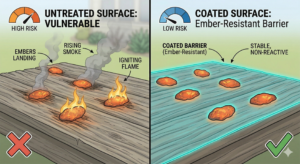
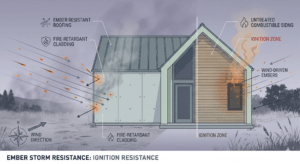
- Ember entry into attic vents is a primary ignition source
Commercial
- Inventory losses may exceed property damage
- Chemicals and packaging materials release more toxins
- Insurance is increasingly tied to mitigation and code compliance
Commercial Wildfire Mitigation isn’t optional anymore—it’s regulatory, financial, and environmental.
10 FAQs About Fire Pollution and Wildfire Defense Systems
- What is released when a house burns?
CO2, PM2.5, dioxins, VOCs, and heavy metals from furniture, electronics, and construction materials. - How toxic is wildfire smoke from homes?
Up to 30 times more hazardous than forest fire smoke due to synthetic materials. - Is Phos-Chek safe?
Short-term for firefighting? Yes. Long-term? Not when runoff enters waterways. - Has Phos-Chek affected the ocean?
Yes. Elevated nitrogen levels have been traced to harmful algal blooms near Southern California beaches. - Can wildfire defense systems reduce air pollution?
Yes. By preventing ignition, they stop toxic emissions at the source. - Do commercial properties need wildfire defense?
Absolutely—especially those in the WUI or with hazardous inventory. - Is foam better than water or retardant?
Not necessarily. Water evaporates quickly, and foam has storage challenges. Retardant has longer surface adhesion. - Is there proof these systems work?
Multiple fire incidents—US and abroad—show over 95% survival rate when systems are active. - Are there alternatives to Phos-Chek?
Localized retardant sprays and early suppression are preferred where possible. - How can I install a system?
Contact Ember Pro for a custom site assessment and system plan.
Final Thoughts
The image of wildfire devastation often focuses on ash and flames. But the real, lasting damage is found in the air, water, and ecosystems that surround the burn zones. Every home that burns is an environmental disaster. Every building lost leaks toxins into the community and the coast.
Wildfire defense systems aren’t just about property—they’re about protection.
From neighborhoods to kelp forests, from attic vents to estuaries, every layer of defense matters.
Let’s stop the burn before it starts.
Visit For More: 1 2 3 4 5 6 7 8 9
References
- EPA Wildfire Smoke and Indoor Air Pollution Study (2023)
- [NOAA Retardant Runoff Monitoring Report (2024)]
- [UC Santa Barbara Coastal Impact Report (2024)]
- NBC LA – Homes Saved in 2025 LA Firestorm
- Spectrum News – Wildfire Defense System Activation
- [Fire Ecology Journal: Toxic Emissions from Wildfire-Impacted Homes (2022)]