
Breadcrumb: Insights, Wildfire Science, Wildfire Defense Systems, California Wildfires
Author: Jim Sprouse, Co-founder of Ember Pro, BS in Environmental Studies from Allegheny College, Certified Wildfire Defense Specialist
Expert Review: Ryan Kresan, COO and Co-founder, Ember Pro
Reading Time: Approximately 10 minutes
Introduction
Homeowners in wildfire prone areas are often told to get the house wet when fire threatens. Roof sprinklers, garden hoses, and exterior spray systems are commonly viewed as frontline defenses against wildfire.
Fire science tells a more precise story.
The National Fire Protection Association, NFPA, has been clear in its guidance. Exterior sprinklers can play a role, but water alone is not a reliable or sufficient wildfire mitigation strategy for homeowners. Wind, evaporation, limited water supply, and system reliability all constrain effectiveness.
At the same time, firefighters combating wildland fires overwhelmingly rely on chemical retardants and foams, not water alone.
This raises a critical question.
Why does fire science favor retardants over water when the goal is preventing ignition, not extinguishing flames?
What NFPA Actually Says About Exterior Sprinklers
NFPA training materials and professional wildfire education programs directly address a common misconception.
The statement that roof sprinklers can effectively resist fire spread and eliminate the need for other roof mitigation is classified by NFPA as fiction.
NFPA explains that exterior sprinklers:
-
- Can aid in fire spread prevention
- Are vulnerable to wind effects
- Depend on uninterrupted water supply
- Are subject to mechanical failure
- Can cause unintended interior water damage
Most importantly, NFPA emphasizes that sprinklers should be used as a supplement, not a replacement, for proven wildfire mitigation strategies.
This guidance aligns directly with observed wildfire behavior and modern fire science.
Cooling Versus Ignition Prevention
To understand why retardants outperform water in wildfire defense systems, it is important to distinguish between cooling and ignition prevention.
Water is effective at cooling active flames when applied continuously and in large volumes. This makes it ideal for structural firefighting when crews can maintain flow and control application.
Wildfires behave differently.
Radiant heat arrives before flames. Embers ignite structures without direct flame contact. Wind disrupts spray patterns. Water evaporates rapidly under heat. Once water is gone, its protective effect disappears completely.
Ignition prevention, not cooling, is the controlling factor for structure survival.
Why Firefighters Use Retardants in Wildland Fire
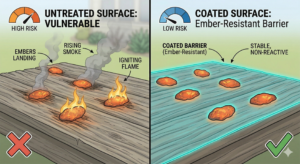
Wildland firefighters rely on chemical retardants and foams because they directly interrupt the combustion process.
Retardants work by:
-
- Altering the chemistry of ignition
- Coating fuels to prevent flame development
- Remaining effective after drying
- Resisting evaporation under heat and wind
Unlike water, retardants continue protecting surfaces after application, which is essential during fast moving, wind driven fires.
Persistence Matters More Than Volume
One of the most critical differences between water and retardants is persistence.
Water protection lasts only as long as surfaces remain wet. Under wildfire conditions, that window is short.
Retardants persist through radiant heat, ember exposure, and delayed flame arrival. This allows them to protect structures during the most critical ignition window, when most homes are lost.
Evaporation and Wind: The Limiting Factors of Water
NFPA identifies wind as a primary factor limiting sprinkler effectiveness.
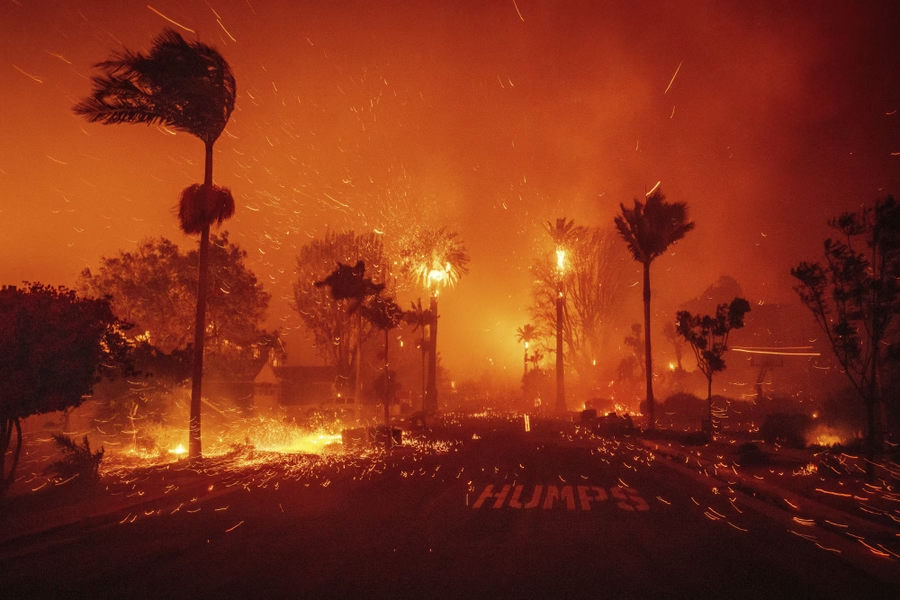
Wind causes uneven spray distribution, strips moisture from surfaces, and accelerates evaporation. During Santa Ana wind events, water droplets may never land where intended.
Retardants adhere to surfaces, remain in place, and continue working even when spray patterns are disrupted.
Why Roof Sprinklers Alone Are the Wrong Question
NFPA does not say sprinklers are useless. It says sprinklers alone are insufficient.
The correct question is not whether roof sprinklers work.
The correct question is what a wildfire defense system must do to prevent ignition.
Fire science shows effective systems must reduce ignition probability, persist through heat and wind, protect during ember exposure, and reinforce defensible space and Zone 0.
Chemical based systems meet these requirements far more reliably than water alone.
Real World Performance of Retardant Based Systems
Real world wildfire outcomes consistently reinforce what fire science predicts. Chemical based wildfire defense systems perform more reliably than water dependent systems, especially during wind driven fires.
In documented wildfire events across California, including recent fires in the Los Angeles region, homes protected by wildfire defense systems that deployed chemical retardants demonstrated markedly higher survivability than surrounding structures. Importantly, in the survivability case studies reviewed, every system associated with a successfully protected structure relied on chemical retardants, not water alone.
These systems succeeded not because they sprayed continuously, but because they treated ignition prone surfaces with a persistent chemical barrier before and during ember exposure.
What the Los Angeles Survivability Data Shows
The survivability analysis reveals a consistent pattern. Homes that survived shared several characteristics:
-
- Retardant based wildfire defense systems were installed and operational
- Defensible space had been established and maintained
- Zone 0 ignition sources were reduced or eliminated
- Ember exposure did not result in sustained ignition
By contrast, nearby homes without chemical protection frequently ignited from embers, even when limited water based mitigation was attempted.
The decisive factor was persistence. Retardant remained on surfaces throughout the fire event, while water based protection evaporated or was exhausted early.
Why Water Systems Fail Under Real Conditions
The limitations of water based systems are not theoretical. They are mathematical.
A typical residential swimming pool holds approximately 25,000 gallons of water. Fire behavior analysis shows that meaningfully wetting even a modest defensible perimeter requires thousands of gallons per application.
Under Southern California wildfire conditions:
-
- Water evaporates rapidly under radiant heat
- Wind strips moisture from surfaces
- Porous soils absorb water quickly
- Continuous reapplication is required to maintain effectiveness
Over a typical evacuation window lasting several hours, maintaining wet surfaces would require well over 50,000 gallons of water, far exceeding what most residential properties can supply.
Once water runs out or evaporates, protection ends.
Why Retardants Perform Better in the Same Scenarios
Retardant based systems operate on a fundamentally different principle.
Rather than attempting to cool surfaces continuously, retardants:
-
- Bond into vegetation and combustible materials
- Interrupt the combustion process
- Remain effective after drying
- Continue protecting against ember exposure long after application
This is why, in real wildfire events, retardant treated properties consistently outperform water protected properties, particularly when systems must function autonomously after evacuation.
As documented in the survivability analysis, retardant based wildfire defense systems not only improved survival outcomes, but also added measurable value, insurability, and buyer confidence.
Retardants and the Home Ignition Zone
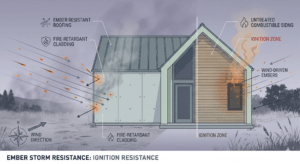
Most homes ignite within the Home Ignition Zone, not from direct flame fronts.
Retardants are especially effective because they protect the exact areas where embers land, reinforce Zone 0, reduce ignition of vegetation near structures, and limit structure to structure fire spread.
This aligns with AB 3074 and California’s shift toward ignition prevention rather than suppression.
NFPA, Fire Science, and Layered Defense
NFPA guidance reinforces a key principle.
Wildfire mitigation is layered.
Defensible space reduces fuel. Home hardening resists ignition. Retardants reinforce protection. Water can supplement but not replace these measures.
Chemical based wildfire defense systems fit squarely within this layered framework.
Frequently Asked Questions
1. Does NFPA say sprinklers do not work?
No. NFPA says they should supplement, not replace, proven mitigation.
2. Why do firefighters use retardants instead of water?
Because retardants persist and interrupt combustion.
3. Does water evaporate during wildfires?
Yes, often rapidly under heat and wind.
4. Are retardants safe for residential use?
Modern ground applied retardants are designed for residential environments.
5. Can water based systems still help?
Yes, when used alongside chemical protection.
6. Do retardants replace defensible space?
No. They reinforce it.
7. Are chemicals effective during ember storms?
Yes, that is where they perform best.
8. Is this aligned with AB 3074?
Yes, ignition prevention is the focus.
9. Do wildfire defense systems rely only on chemicals?
They are designed around chemical protection, not water alone.
10. What is the biggest takeaway?
Preventing ignition matters more than getting surfaces wet.
References
-
- National Fire Protection Association – Reducing Wildfire Risk to Property, Professional Training Materials
- Ember Pro – Survivability Sells, How a Wildfire Defense System Adds Value and Peace of Mind
- Ember Pro – Why Water Will Not Save Your Home from Wildfire, But Retardant Might
- Insurance Institute for Business and Home Safety – Wildfire Structure Ignition and Ember Exposure Research
- California Assembly Bill 3074 – Fire Prevention, Wildfire Risk, Defensible Space, Ember Resistant Zones
Call to Action
Fire science is clear. Water alone is not enough.
If your wildfire strategy relies solely on sprinklers, hoses, or water storage, it is incomplete.
Ember Pro designs wildfire defense systems that align with NFPA guidance and real world wildfire behavior.
Schedule a free wildfire defense consultation to learn how chemical based protection fits into a layered wildfire mitigation strategy.
Related Articles
-
- What Is the Home Ignition Zone and Why Ladder Fuels Matter
- Why Water Alone Will Not Save Your Home from Wildfire
- How Effective Are Wildfire Defense Systems During High Winds