
Why Water Won’t Save Your Home from Wildfire — But Retardant Might
Author: Jim Sprouse, Co-founder of Ember Pro, BS in Environmental Studies from Allegheny College, Certified Wildfire Defense Specialist
Expert Review: Ryan Kresan, COO and Co-founder, Ember Pro
Breadcrumb: Insights, Wildfire Science, Wildfire Defense Systems, California Wildfires
Introduction

One of the most common questions California homeowners ask when wildfire threatens is simple and logical:
Can I use water to protect my home?
After all, water puts out fire. Many homes have swimming pools, irrigation systems, or city water connections. On the surface, it feels like the solution is already there.
Unfortunately, wildfire does not behave like a house fire. In California’s dry climate, steep terrain, porous soils, and high-wind events like Santa Ana winds, water alone is rarely effective as a defensive strategy once a wildfire approaches.
This is why modern wildfire defense systems increasingly rely on fire retardant, not water, as the primary protective agent. The difference is not opinion. It is physics, chemistry, and real-world fire behavior.
This article explains why water-based approaches fall short, how wildfire retardant works differently, and why retardant-based wildfire sprinkler systems provide meaningful protection when it matters most.
The Reality of Wildfire Behavior in California
Wildfires in California are driven by three dominant factors:
- Wind, especially downslope and offshore winds
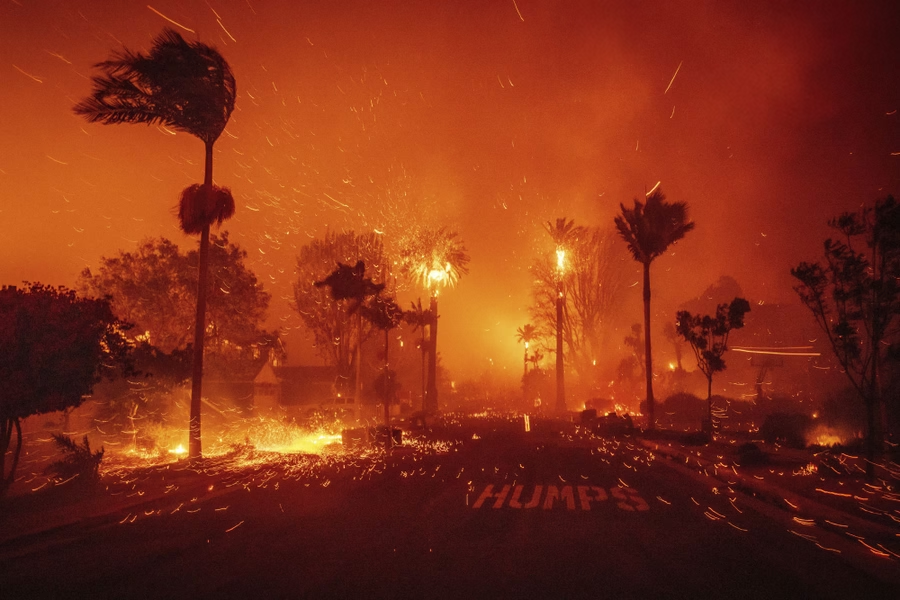
- Embers, not flame fronts
- Extremely low fuel moisture
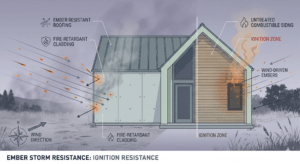
Most homes that burn do not ignite because a wall of flame touches them. They burn because embers accumulate in vulnerable areas, especially within five feet of the structure, now known as Zone 0 under AB 3074.
Once ignition occurs, suppression is often impossible.
Any effective wildfire defense system must address embers first, not just heat or flame.
The Science, Water vs Wildfire
Let’s look at what it actually takes to use water defensively.
How Much Water Are We Really Talking About
A typical residential swimming pool holds about 25,000 gallons of water.
To adequately wet just 1.5 acres, which is not an estate-sized property but a common defensible perimeter in high-risk areas, you would need more than 10,000 gallons per application to apply a quarter inch of water to the surface.
That quarter inch is not a luxury. It is the minimum amount needed to penetrate the surface layer of soil and vegetation.
Under wildfire conditions, that water does not last.
During high heat and wind, evaporation accelerates dramatically. In practice, you would need to reapply water every 20 to 30 minutes to maintain surface moisture.
Over a typical evacuation window of approximately three to three and a half hours, this can exceed 50,000 to 100,000 gallons of water, depending on conditions.
This calculation and its assumptions are documented and expanded in the supporting research you provided .
Why Water Fails in Southern California Conditions
Evaporation Happens Fast
Under Santa Ana wind conditions, water evaporates rapidly. Once it dries, it provides zero ongoing protection.
Water does not bind to surfaces. It does not remain active. It does not stop embers once dry.
Soils Do Not Hold Water
Southern California soils are highly porous. When large volumes of water are applied quickly, most of it infiltrates downward rather than remaining at the surface.
This means that even massive water applications result in short-lived surface wetness, followed by rapid drying.
Water Cannot Be Applied Continuously
Once evacuation orders are issued, homeowners are gone. Firefighters are stretched thin. Power may be out.
An irrigation or pool-based system that runs dry after a short period leaves the property completely unprotected when embers arrive later, which is often the most dangerous phase of the fire.
The Hidden Cost of Water-Based Defense Systems
Many homeowners assume water is cheap and retardant is expensive. The opposite is often true when systems are properly compared.
A true water-based wildfire defense system requires:
- Large storage tanks, often 50,000 gallons or more
- High-capacity pumps
- Backup power
- Automated valves and controls
- Extensive piping and sprinkler networks
Installed correctly, these systems often exceed $50,000, not including maintenance, testing, and water costs. City water may not even be available during a wildfire, as municipal systems prioritize firefighting operations.
Despite this investment, protection lasts only while water is actively flowing.
How Wildfire Retardant Works Differently
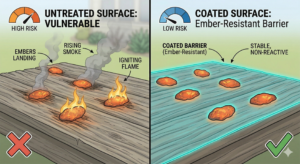
Wildfire retardants are designed for one purpose: to prevent ignition, especially from embers.
How Retardant Protects Surfaces
Modern wildfire retardants, including products like Clore and CitroSafe, work by:
- Bonding into cellulose in vegetation and wood
- Altering combustion chemistry
- Creating a self-extinguishing surface
Once applied, retardant continues to work even after it dries. This is the key difference.
An ember landing on a retardant-treated surface is far less likely to ignite that material. This is exactly what water cannot do once evaporation occurs.
The science behind this mechanism is well documented and referenced in the source material .
Retardant and Ember Defense
Embers are responsible for the majority of home losses during wildfires. They arrive:
- Ahead of the fire front
- After the fire front
- In waves, sometimes for hours or days
Water provides protection only at the moment of application. Retardant provides protection for the duration of its presence on the surface.
This makes retardant especially effective for:
- Roof edges
- Eaves and vents
- Fences and decks
- Landscaping within Zone 0 and Zone 1
- Accumulation points where embers settle
This is why wildfire defense systems that rely on retardant consistently outperform water-only systems in real wildfire conditions.
Addressing Common Concerns About Retardant
Is Retardant Permanent
No. Retardant degrades over time due to:
- Rain
- Irrigation
- Ultraviolet exposure
That is why Ember Pro systems are designed to be activated when a real fire threat exists, not sprayed once and forgotten.
Does Retardant Replace Defensible Space
No. Retardant works best when combined with:
- Defensible space
- Zone 0 compliance
- Home hardening measures
Under AB 3074, the five feet around a structure must be ember-resistant. Retardant-based systems are designed specifically to protect this most vulnerable zone.
Why Automated Retardant Systems Make Sense
Wildfires do not wait for homeowners to be present.
Ember Pro wildfire defense systems are designed to:
- Activate remotely or automatically
- Operate during evacuation
- Function without reliance on city water
- Target high-risk areas based on wind direction and ember behavior
Unlike improvised solutions, these systems are engineered for real wildfire conditions, including high winds and power outages.
Water Still Has a Role, But a Limited One
Water is not useless. It has value for:
- Active firefighting by trained crews
- Structure cooling during direct suppression
- Short-term wetting when used continuously
What water cannot do is provide long-duration ember protection without massive infrastructure and continuous operation.
That is why water alone is not a realistic solution for homeowners once evacuation begins.
Environmental and Practical Considerations
Retardant systems also reduce the need for large-scale aerial retardant drops, which have documented environmental impacts when misapplied near waterways.
By protecting structures locally, wildfire defense systems:
- Reduce overall fire spread
- Decrease toxic smoke from burning buildings
- Minimize runoff and contamination
- Protect neighboring properties
Preventing a structure from burning is one of the most effective environmental mitigation actions available during wildfire events.
Why Ember Pro Recommends Retardant-Based Defense
At Ember Pro, we install wildfire defense systems designed for California conditions.
Our approach emphasizes:
- Retardant over water for ember defense
- No roof penetrations unless required
- No trenching unless necessary
- Strategic spray head placement based on wind patterns
- Protection of Zone 0 and beyond
We do not rely on outdated assumptions about water alone being sufficient. The science, the math, and real-world fire outcomes all point in the same direction.
Frequently Asked Questions
- Can I use my pool to protect my home from wildfire?
In most cases, no. The water volume and reapplication rate required make this impractical. - Is a roof sprinkler system for fire effective?
Water-only roof sprinkler systems provide limited short-term benefit and do not stop embers once dry. - What is the advantage of wildfire retardant?
Retardant remains effective after drying and resists ignition from embers. - Does retardant harm landscaping?
When applied properly, modern retardants are designed to minimize long-term impact. - How long does retardant last?
Until it is washed away by rain or irrigation or degraded by UV exposure. - Is this compliant with AB 3074?
Yes. Retardant systems support Zone 0 and defensible space requirements. - Do wildfire sprinkler systems require permits?
Most Ember Pro systems do not unless trenching or electrical upgrades are needed. - Can this be used on commercial buildings?
Yes. Commercial properties often benefit even more due to larger footprints and higher exposure. - Is water ever better than retardant?
Water is useful for active firefighting but not for long-duration ember defense. - What is the best way to protect my home?
A layered approach combining defensible space, home hardening, and a retardant-based wildfire defense system.
Final Thoughts
Wildfire defense is not about tradition or intuition. It is about understanding how fire actually behaves.
Water feels familiar, but it evaporates, infiltrates, and disappears. Retardant stays, resists ignition, and protects against the real enemy, embers.
In wildfire country, the difference between loss and survival often comes down to whether a home was prepared before evacuation, not whether someone was there with a hose.
That is why the future of wildfire protection is not water alone. It is smart, targeted, retardant-based defense systems designed for the realities of California wildfire.