
By Jim Sprouse, Co-founder of Ember Pro
Wildfire risk is no longer just a residential concern. Across California, commercial properties, from office parks and retail centers to warehouses, manufacturing facilities, and hospitality venues, face growing exposure to wildfire damage, regulatory requirements, and insurance challenges. Yet most business owners and property managers have not developed wildfire mitigation strategies tailored to commercial operations.
This comprehensive guide covers everything commercial property owners and managers need to know about commercial wildfire mitigation for business property: the unique risks businesses face, regulatory requirements, defensible space for commercial sites, employee safety obligations, business continuity planning, insurance considerations, the ROI of mitigation investment, and how Ember Pro supports commercial clients.
Editor’s note: Your insurance situation depends heavily on your property’s actual fire exposure. Our free risk assessment factors in official CAL FIRE data to show what your risk level actually is — useful context before talking to your carrier.
Why Commercial Properties Face Unique Wildfire Risks
Commercial properties present wildfire risks that differ significantly from residential properties. These differences require tailored mitigation approaches rather than simply scaling up residential strategies.
Larger Footprints and Complex Structures
Commercial buildings typically have larger roof areas, more complex HVAC systems with multiple air intake points, loading docks with open bays, flat roof sections where embers can accumulate, and extensive parking areas that may border wildland vegetation. Each of these features creates ignition pathways that do not exist in typical residential construction.
Stored Materials and Inventory Risk
Unlike homes, commercial properties often contain large quantities of combustible inventory, chemicals, packaging materials, or equipment. A warehouse full of product represents not just a fire risk but a potential accelerant. Manufacturing facilities may store flammable materials that create explosion risks during fire events. Even office buildings contain significant quantities of paper, electronics, and furnishings that increase fire load.
Employee Safety Obligations
Commercial property owners have legal obligations to employees that go beyond residential owner responsibilities. Cal/OSHA requires employers to maintain safe working conditions, which in fire-prone areas includes wildfire preparedness. Failure to plan for wildfire events can result in regulatory citations, worker injury claims, and litigation.
Business Continuity Impact
When a residence burns, a family loses their home. When a commercial property burns, the impacts cascade: employees lose jobs, customers lose access to services, supply chains are disrupted, and the business may never recover. The average small business that experiences a major disaster without a continuity plan has a significantly reduced chance of surviving long-term.
Regulatory Requirements for Commercial Properties
Commercial properties in California must comply with multiple wildfire-related regulatory frameworks. Understanding which requirements apply to your specific property is the first step in developing a mitigation plan.
California Building Code Chapter 7A
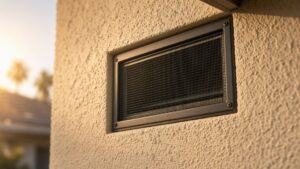
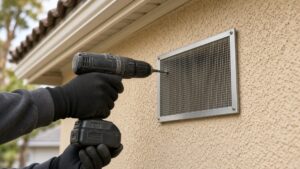
Title 24 Chapter 7A applies to commercial buildings in fire hazard severity zones, not just residential structures. New commercial construction and major renovations must meet ignition-resistant construction standards including Class A fire-rated roofing, non-combustible exterior cladding, tempered or dual-pane windows, enclosed eaves and soffits, and ember-resistant vent screening.
Existing commercial buildings are not retroactively required to meet Chapter 7A standards in most jurisdictions, but any component replacement (roof, siding, windows) triggers compliance for that component. Some jurisdictions have enacted local ordinances requiring proactive commercial building hardening.
PRC 4291 Defensible Space
Public Resources Code Section 4291 requires defensible space maintenance around all habitable structures in fire hazard severity zones, including commercial buildings. The standard 100-foot clearance requirement applies, with specific vegetation management prescriptions for each zone. Commercial properties with larger perimeters and more complex landscapes often face higher compliance costs than residential properties.
AB 3074 Zone 0
AB 3074’s Zone 0 requirements apply to commercial structures in Very High fire hazard severity zones. The first five feet around the building must be maintained to the strictest standards, including removal of all dead vegetation, specific tree spacing requirements, and non-combustible ground cover. For commercial buildings with extensive landscaping, this requirement can necessitate significant design changes.
Cal/OSHA Fire Safety Requirements
Cal/OSHA regulations require employers to establish fire prevention plans, maintain fire extinguishers and suppression equipment, provide employee training on fire safety procedures, ensure adequate exit routes and emergency lighting, and develop emergency action plans that address wildfire scenarios. These requirements apply in addition to building code standards and defensible space regulations.
Local Fire Department Requirements
Many local fire departments impose additional requirements on commercial properties, including fire access road standards (minimum width, clearance, turnaround areas), fire sprinkler system requirements, fire alarm and detection system standards, hazardous materials storage and reporting, and annual fire safety inspections.
Commercial property owners should contact their local fire marshal to confirm all applicable requirements. Local standards can significantly exceed state minimums, particularly in jurisdictions that have experienced major wildfire events.
Commercial Defensible Space: Beyond the 100-Foot Rule
Defensible space for commercial properties requires a more nuanced approach than the standard residential framework. Commercial sites typically have multiple buildings, parking structures, loading areas, and landscaped sections that create complex fire exposure patterns.
Perimeter Vegetation Management
The perimeter of a commercial property is the primary defense against approaching wildfire. Effective perimeter management includes maintaining cleared buffer zones between the property boundary and the nearest wildland vegetation, installing irrigated landscape buffers using fire-resistant plant species, creating fuel breaks along property boundaries that abut open space, and removing dead vegetation, accumulated debris, and ladder fuels within 100 feet of all structures.
Parking Areas and Access Roads
Parking lots can serve as effective firebreaks if properly maintained. Ensure that landscaping islands and medians use fire-resistant plants, that accumulated vegetation debris is regularly cleared from parking areas, and that access roads are clear of overhanging vegetation that could impede emergency vehicles or ignite during a fire event.
Loading Docks and Service Areas
Loading docks present particular vulnerability because they often have open bays facing upslope or toward wildland areas. Mitigation measures include installing fire-rated roll-down doors on loading bays, clearing all combustible materials from exterior loading areas during fire season, ensuring dumpsters and waste containers are positioned away from building walls, and maintaining a non-combustible perimeter around service areas.
Rooftop Equipment and Systems
Commercial rooftops typically contain HVAC units, ventilation systems, solar panels, and communication equipment. These create ember collection points and potential ignition sources. Regular clearing of debris from rooftop areas, installation of ember-resistant screens on air intake openings, and inspection of rooftop equipment mounting systems are essential maintenance tasks.
Not sure which step to prioritize first? Our wildfire risk calculator shows your CAL FIRE zone and exposure level — so you know exactly where to start.
Employee Safety and Evacuation Planning
Commercial wildfire preparedness must include comprehensive employee safety measures. Unlike residential situations where individuals make their own evacuation decisions, employers are responsible for ensuring employee safety during wildfire events.
Wildfire Emergency Action Plan
Every commercial property in a fire-prone area should have a written wildfire emergency action plan that includes designated evacuation routes and assembly points, employee notification procedures including after-hours notification, roles and responsibilities for key staff during emergencies, procedures for securing equipment, inventory, and data before evacuation, and communication protocols with local fire and emergency management agencies.
Employee Training
Conduct annual wildfire safety training for all employees. Training should cover how to recognize wildfire warning signs and red flag conditions, evacuation procedures and assembly point locations, proper use of fire extinguishers and emergency equipment, air quality awareness and respiratory protection during smoke events, and procedures for sheltering in place if evacuation is not possible.
Air Quality Management
Wildfire smoke can affect commercial operations even when fire does not directly threaten the property. Cal/OSHA’s wildfire smoke protection regulation requires employers to monitor air quality during wildfire events, provide respiratory protection when AQI exceeds 151, modify outdoor work activities based on air quality conditions, and maintain a supply of N95 or equivalent respirators.
Business Continuity Planning for Wildfire
Business continuity planning addresses how your business will survive and recover if wildfire damages or destroys your property, disrupts operations, or displaces employees.
Critical Asset Protection
Identify and prioritize protection of critical business assets including IT infrastructure and data (ensure off-site backups), essential equipment and machinery, inventory and raw materials, financial records and legal documents, and customer data and relationship management systems.
Alternate Operations Plans
Develop plans for operating from alternate locations if your primary facility is damaged or inaccessible. This includes identifying backup facilities, establishing remote work capabilities, pre-positioning critical supplies and equipment, and maintaining relationships with partner businesses that could provide temporary space.
Supply Chain Risk Assessment
Evaluate your supply chain for wildfire vulnerability. If key suppliers are located in fire-prone areas, disruptions to their operations can affect your business even if your property is undamaged. Diversifying suppliers and maintaining safety stock of critical materials reduces this exposure.
Insurance for Commercial Properties in Fire-Prone Areas
The wildfire insurance challenges affecting residential properties are equally severe for commercial properties. Understanding commercial wildfire insurance requires attention to several distinct policy types and coverage considerations.
Commercial Property Insurance
Standard commercial property insurance covers the building structure and its contents. However, wildfire-specific considerations include whether the policy covers the full replacement cost of the building to current code standards, whether inventory and equipment are covered at replacement value or depreciated value, whether debris removal and site restoration are included, and whether there are wildfire-specific exclusions or sublimits.
Business Interruption Insurance
Business interruption (BI) insurance covers lost income and continuing expenses when your business cannot operate due to a covered event. For wildfire scenarios, key questions include the waiting period before BI coverage begins, the coverage period (how many months of lost income are covered), whether evacuation orders that close the business without physical damage are covered, and whether supply chain disruptions from wildfire are included.
How Mitigation Affects Commercial Insurance
Documented wildfire mitigation can significantly improve your commercial insurance position. Insurers evaluating commercial properties look for evidence of regulatory compliance, defensible space maintenance records, building hardening improvements, emergency preparedness plans, and professional wildfire assessments.
Commercial properties with comprehensive mitigation documentation are more likely to obtain coverage, receive competitive premiums, and have claims honored without dispute.
ROI of Commercial Wildfire Mitigation
Commercial wildfire mitigation is an investment, and like any business investment, it should be evaluated on its return. The ROI calculation for wildfire mitigation includes both direct and indirect benefits.
Direct Financial Benefits
Insurance premium reduction or avoidance of non-renewal is often the largest direct financial benefit. Commercial properties that demonstrate mitigation can save 10 to 30 percent on annual premiums compared to unmitigated properties in similar fire zones. Over a ten-year period, these savings can exceed the total cost of mitigation implementation.
Regulatory compliance avoidance of fines provides additional direct savings. Non-compliance penalties of $100 to $500 per day can accumulate rapidly for commercial properties with large perimeters or multiple violations.
Indirect Financial Benefits
Business continuity protection is the most significant indirect benefit. The cost of business interruption from wildfire damage, including lost revenue, employee displacement, customer loss, and reconstruction delays, typically dwarfs the cost of prevention. Employee retention and recruitment benefits from demonstrating commitment to workplace safety. Property value protection in a market increasingly sensitive to wildfire risk. Liability risk reduction, lowering the probability of negligence claims from employees, customers, or neighboring properties.
Cost Benchmarks
Commercial wildfire mitigation costs vary significantly by property size, vegetation conditions, and structural characteristics. General benchmarks include initial wildfire risk assessment at $5,000 to $25,000, annual vegetation management at $10,000 to $75,000 depending on acreage, building hardening improvements at $25,000 to $200,000 depending on scope, active wildfire defense system installation at $15,000 to $100,000 depending on coverage area, and ongoing annual maintenance at $5,000 to $30,000.
For most commercial properties, total mitigation investment over five years represents less than one year’s potential business interruption loss from a wildfire event.
How Ember Pro Supports Commercial Properties
Ember Pro provides specialized commercial wildfire mitigation services designed for the unique needs of business properties. Our commercial services include:
Commercial Property Assessments: We evaluate your entire facility including building envelope, vegetation, access routes, utility systems, and surrounding landscape to identify vulnerabilities and prioritize mitigation investments.
Defensible Space Planning and Implementation: We develop commercial-grade vegetation management plans that address perimeter zones, parking areas, loading docks, and landscaped sections. We coordinate implementation with qualified contractors experienced in commercial-scale vegetation work.
Regulatory Compliance Support: We help commercial property owners understand and comply with all applicable wildfire regulations, including Chapter 7A, PRC 4291, AB 3074, Cal/OSHA requirements, and local fire department standards.
Employee Safety Program Development: We assist in developing wildfire emergency action plans, employee training programs, and air quality management protocols that meet Cal/OSHA requirements.
Insurance Documentation: We provide comprehensive documentation packages that demonstrate your mitigation efforts to insurance underwriters, supporting policy renewal, premium negotiation, and claims defense.
Ongoing Maintenance Programs: We offer annual maintenance contracts that ensure your commercial property remains compliant and protected year-round, with scheduled vegetation management, system inspections, and compliance verification.
Industry-Specific Considerations
Hospitality and Tourism
Hotels, resorts, and tourism operations face unique wildfire challenges including guest safety and evacuation logistics, seasonal staffing that complicates emergency planning, outdoor amenities and landscaping that increase fire exposure, and reputation risk from wildfire proximity even without direct damage.
Healthcare and Senior Care
Medical facilities and senior living communities must plan for patients and residents who cannot self-evacuate. Regulatory requirements are more stringent, and the consequences of inadequate planning are more severe.
Agriculture and Wineries
Agricultural operations face crop loss, equipment damage, and smoke taint risks. Vineyards and wineries in fire-prone regions must balance vegetation management with agricultural productivity and plan for smoke exposure during critical growing periods.
Warehousing and Logistics
Large warehouse facilities with high-value inventory require particular attention to loading dock protection, sprinkler system adequacy, and inventory staging to minimize total loss scenarios.
Frequently Asked Questions
Does commercial wildfire mitigation differ from residential?
Yes. Commercial properties have larger footprints, more complex structures, employee safety obligations, inventory and equipment risks, and business continuity concerns that require specialized mitigation approaches beyond residential standards.
Are commercial properties required to have defensible space?
Yes. PRC 4291 and AB 3074 apply to all structures in fire hazard severity zones, including commercial buildings. The same defensible space clearance requirements apply, though implementation is more complex for commercial sites.
How does wildfire affect commercial insurance?
Commercial insurers in California are increasingly restricting coverage, raising premiums, and requiring documented mitigation for properties in fire-prone areas. Business interruption coverage is particularly important and often inadequately addressed in commercial policies.
What is Cal/OSHA’s role in wildfire preparedness?
Cal/OSHA requires employers to maintain safe working conditions, which includes wildfire emergency planning, smoke exposure protection, and employee training. Non-compliance can result in citations and fines.
How long does it take to implement a commercial mitigation plan?
Initial assessment and planning typically takes two to four weeks. Vegetation management can be completed in one to three months depending on property size. Building improvements may take three to twelve months. Ongoing maintenance is continuous.
Can wildfire mitigation be a tax-deductible business expense?
Many wildfire mitigation costs are deductible as ordinary business expenses, including vegetation management, building maintenance, safety equipment, and employee training. Consult with your tax advisor for specific applicability to your situation.
References
- California Building Standards Commission — Title 24, Chapter 7A: Materials and Construction Methods for Exterior Wildfire Exposure
- California Public Resources Code Section 4291 — Defensible Space Requirements
- California Assembly Bill 3074 — Zone 0 and Enhanced Defensible Space Standards
- Cal/OSHA Title 8 Section 5141.1 — Protection from Wildfire Smoke
- Cal/OSHA Title 8 Section 3221 — Fire Prevention Plan
- Insurance Institute for Business & Home Safety — Commercial Wildfire Risk Research
- Federal Emergency Management Agency — Business Continuity Planning Guide
- CAL FIRE — Commercial Property Fire Safety Guidelines
Related Articles
- Complete Guide to Defensible Space
- Understanding Zone Zero Requirements
- Wildfire Insurance Guide for California Properties
- California Fire Safety Compliance Checklist
- California Wildfire Laws You Need to Know
- Commercial Wildfire Defense Systems
- Structural Hardening for Fire Resistance
Curious about your property’s actual wildfire risk? Our free calculator shows your CAL FIRE zone, exposure level, and recommended next steps based on your address.
Get your free risk score