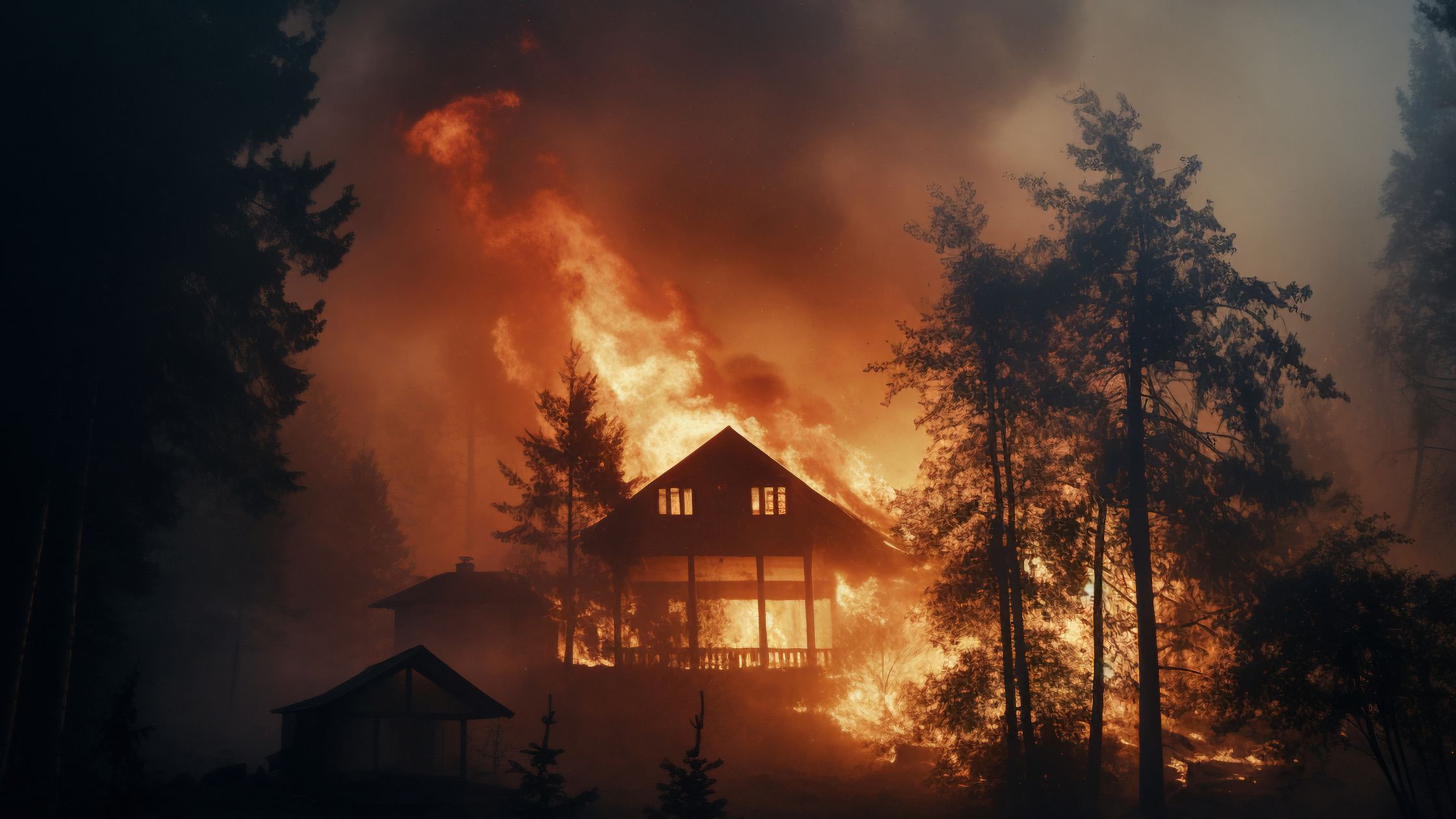

Wildfire Defense System Effectiveness Report
Residential wildfire defense systems are gaining attention as homeowners, brokers, insurers, and fire professionals look for stronger ways to reduce structure loss in wildfire exposed areas. During the January 2025 Los Angeles Fires, Frontline Wildfire Defense reported that 59 of 61 Frontline protected homes remained intact. Frontline also noted that not all of those homes were within the official burn perimeter, but that they were located in areas at risk from ember exposure or active wildfire conditions. [1]
That distinction matters. These reported outcomes are encouraging, but they should not be treated as a complete industry wide effectiveness rate. To properly evaluate wildfire defense systems, the industry needs more detailed data on exposure, system type, activation timing, agent used, maintenance status, and post fire outcomes.
Unlike water based suppression, certain fire inhibiting and retardant based agents are designed to remain on treated surfaces after drying. Depending on the product used, this can create a protective layer that continues reducing ignition risk until it is washed away, physically removed, degraded, or otherwise depleted.
Survival Rate Data
Frontline Wildfire Defense reported that 59 of 61 protected homes remained intact during the January 2025 Los Angeles Fires. [1] NBC Bay Area also reported Frontline’s claim that 61 customer homes were threatened and 59 survived. [2]
These outcomes are promising, but they should be understood as reported field results from a specific event, not a universal survival rate for all wildfire defense systems.
How the System Works
A wildfire defense system is designed to reduce ignition risk by applying water, foam, fire inhibitor, retardant, or another approved agent through strategically placed spray heads around the structure and surrounding vulnerable areas.
A professionally designed system may include:
- Roofline or eave mounted spray heads
- Perimeter spray heads
- Dedicated tanks
- Pumps
- Distribution lines
- Manual activation controls
- Remote activation capability
- Backup power
- Fire inhibiting or retardant based agents
- Coverage focused on vulnerable and combustible areas
This is not the same as a basic water sprinkler system. Water works primarily while it remains wet. In hot, dry, windy wildfire conditions, water can evaporate, run off, or soak into the ground quickly. Once it is gone, its protective value drops.
Fire inhibitor and retardant based systems work differently. Depending on the agent used, they may continue reducing ignition risk after drying. That makes the agent, the concentration, the coverage area, and the timing of activation important parts of system performance.
Key technical mechanisms:
- Non evaporating protection: Water can dry quickly in wildfire conditions. Certain fire inhibiting and retardant based agents are designed to remain on treated surfaces after drying and continue reducing ignition risk until washed away, physically removed, degraded, or otherwise depleted.
- Targeted coverage: Spray heads can be positioned along rooflines, under eaves, and around perimeter areas to treat vulnerable surfaces and combustible zones.
- Coverage overlap: Adjacent spray heads should be designed to overlap where appropriate so key vulnerabilities are not missed.
- Remote activation: Systems can be designed for remote activation after evacuation, allowing deployment without requiring the homeowner to remain on site.
- Independent operation: Systems can be designed with dedicated tanks, pumps, and backup power so they do not rely solely on municipal water or grid power during a wildfire event.
Effectiveness Under Extreme Conditions
A wildfire defense system should be evaluated based on how it responds to the conditions that commonly cause residential wildfire losses: ember exposure, radiant heat, evacuation, water supply disruption, and power failure.
| Condition | System Response | Design Consideration |
|---|---|---|
| Grid power outage | Backup power or independent power source | Continued operation during utility failure |
| Mandatory evacuation | Remote activation after evacuation | Homeowner does not need to remain on site |
| Extended ember exposure | Fire inhibiting or retardant based agent may continue reducing ignition risk after drying | Product specific testing and proper coverage are required |
| Water supply failure | Dedicated tank or stored agent supply | Reduced dependence on hydrant pressure or municipal water |
| Vulnerable exterior areas | Targeted treatment of eaves, vents, gutters, decks, fences, vegetation, and other ignition points | Coverage should be based on property specific risk |
Cost Effectiveness Analysis
A wildfire defense system can cost significantly less than the financial impact of losing a home to wildfire. Actual costs vary based on property size, terrain, system design, tank size, agent type, pump requirements, and coverage area.
| Cost Category | Amount | Notes |
|---|---|---|
| Wildfire defense system, installed | $15,000 to $40,000 | Varies by property size, system design, and terrain |
| Home rebuilding, California average | $400,000 to $800,000 | Varies widely by location, size, finishes, and construction costs |
| Temporary housing during rebuild | $36,000 to $72,000 | Based on $2,000 to $4,000 per month for 18 to 36 months |
| Uninsured personal property loss | $50,000 to $200,000 | Depends on policy limits and contents coverage |
Total loss scenario cost, including rebuilding, displacement, and uninsured losses: $486,000 – $1,072,000. System cost as a percentage of potential total loss: approximately 1.4 percent to 8.2 percent.
Independent Standards and Compliance
Residential wildfire defense systems operate within a broader framework of national standards, state building codes, fire protection guidance, and insurance regulations.
Relevant standards and policy frameworks may include:
- NFPA 1144 — Standard for Reducing Structure Ignition Hazards from Wildland Fire.
- International Wildland Urban Interface Code — Adopted by California for structures in wildfire-prone areas.
- California Building Code Chapter 7A — Ignition-resistant construction requirements for WUI areas.
- AB 3074 — Zone 0 ember resistant zone within 0-5 feet of structures.
- California Safer from Wildfires framework — Requires insurers to consider wildfire mitigation in underwriting decisions.
Ember Pro holds CSLB License #1142407.
Any fire inhibiting or retardant based agent used in a wildfire defense system should be supported by clear product documentation, third party testing, safety data, environmental data, and proper use instructions.
Limitations and Honest Assessment
No wildfire defense system guarantees survival. Responsible disclosure of limitations is essential for informed decision making.
Potential limitations include:
- Sustained direct flame contact: From nearby burning structures.
- Heavy unmanaged vegetation: Within the treatment zone.
- Combustible materials in Zone 0: Materials within 0-5 feet of the structure.
- Open vents or unprotected ember entry points: Allowing ember intrusion into the structure.
- Structural ignition from interior sources: If fire enters through an unprotected opening, exterior treatment cannot prevent interior ignition.
- Delayed activation: Late deployment reduces effectiveness.
- Activation failure: If the homeowner is unreachable and no automated trigger is configured.
- Lack of system maintenance: Unmaintained systems may not perform as designed.
- Catastrophic structural loads: Collapse of adjacent structures onto a protected property.
Wildfire defense systems are a mitigation layer. They are not a replacement for defensible space maintenance, ignition resistant building materials, ember resistant vents, Zone 0 improvements, and ongoing property maintenance.
Frequently Asked Questions
What is the survival rate of homes with wildfire defense systems?
Frontline Wildfire Defense reported that 59 of 61 Frontline protected homes remained intact during the January 2025 Los Angeles Fires. [1] This is a promising reported field outcome, but it should not be treated as a universal effectiveness rate for all wildfire defense systems. More exposure adjusted data is needed.
How much does a wildfire defense system cost compared to rebuilding?
Installed systems commonly range from $15,000 to $40,000, depending on property size and system complexity. Rebuilding a destroyed home in California can cost hundreds of thousands of dollars or more, before including displacement, contents loss, code upgrades, and insurance gaps.
Do wildfire defense systems work during power outages?
They can, if they are designed with backup power or independent power. System design matters. A system that depends entirely on grid power may not perform the same way as one with backup power.
What type of agent is used?
Systems may use water, foam, fire inhibitors, retardants, or hybrid approaches. Ember Pro uses third party tested, non toxic agents and evaluates product safety, performance, and environmental documentation as part of system design.
What can wildfire defense systems not protect against?
No system can guarantee protection against every wildfire condition. Limitations may include sustained direct flame contact, interior ignition, unmanaged vegetation, activation failure, poor maintenance, and severe exposure from adjacent structure loss.
Request a Wildfire Risk Assessment
Ember Pro provides site specific wildfire risk assessments, home hardening recommendations, and wildfire defense system design for California properties.
Schedule Assessment | CSLB #1142407 | (858) 939-9345
References
[1] Frontline Wildfire Defense, LA Fires Case Study. Frontline reported that 59 of 61 protected homes remained intact during the 2025 Los Angeles fire outcomes, while noting that not all homes were within the official burn perimeter.
[2] NBC Bay Area, “See how new tech helped homes defend themselves from LA firestorm.” NBC reported Frontline’s claim that 61 customer homes were threatened and 59 survived.