
AB 3074 is the 2020 California law that created “Zone 0” — the ember-resistant zone in the first five feet around your home. Authored by Assemblymember Laura Friedman, it amended Public Resources Code 4291 to require a noncombustible buffer immediately surrounding structures in high fire-risk areas. If you own property in a Very High Fire Hazard Severity Zone or the State Responsibility Area, this is the statute that will reshape your fence line, your mulch, and the first five feet of your yard. Here is what it says, when it takes effect, and what to do now.
Not sure which step to prioritize first? Our wildfire risk calculator shows your CAL FIRE zone and exposure level — so you know exactly where to start.
What AB 3074 Actually Requires
Before this bill, California’s defensible space law asked homeowners to clear brush and thin vegetation out to 100 feet. The 2020 legislation added a new, stricter innermost band and directed the state to write detailed standards for it.
The core idea is that the five feet touching your house must be as close to noncombustible as possible. That means no bark mulch, no firewood piles, no combustible fencing tied to the wall, and no vegetation crowding the foundation or growing under decks.
It is a shift in philosophy as much as a rule. The old approach was “reduce the fuel.” The new approach for the innermost zone is “eliminate the fuel entirely.”
How the law amended PRC 4291
Public Resources Code 4291 is the backbone of California defensible space law. AB 3074 inserted the requirement for an “ember-resistant zone” within five feet of a structure and instructed the Board of Forestry and Fire Protection to develop the regulation defining exactly what that zone must contain.
In other words, the statute set the mandate, then handed the technical rulemaking to the fire experts. That two-step design is why the law exists on paper before the enforceable checklist is fully live.
Why the Legislature Wrote It
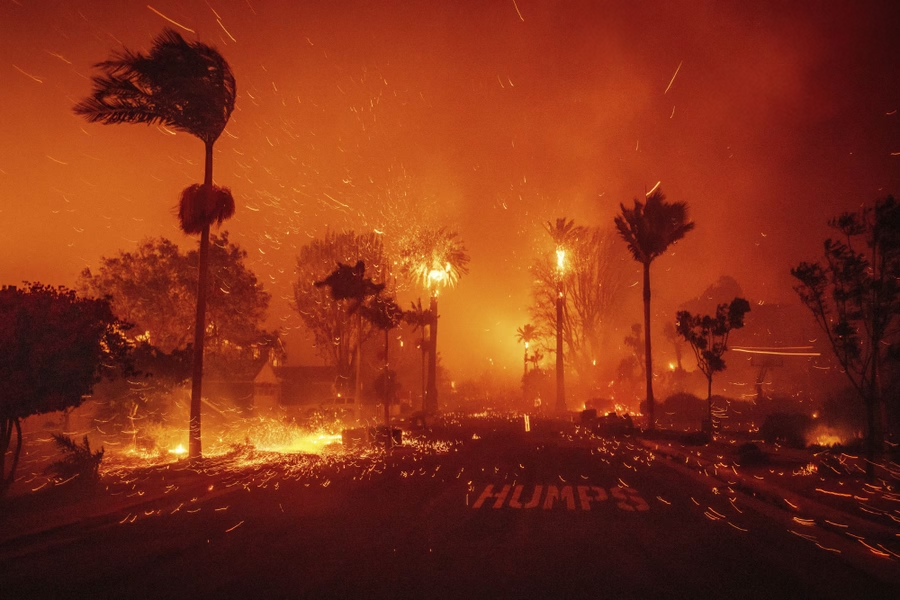
California’s worst losses — Tubbs, Camp, Woolsey, and the January 2025 Los Angeles fires — share a pattern. Homes ignited from wind-blown embers and small flames right against the structure, not from the main flame front.
Embers travel a mile or more ahead of a fire and pile up against walls, fences, and decks. If they find bark mulch or a wood fence, they start a fire. If they find gravel and metal, they cool and die.
The 2020 law targets that exact failure point. Clearing brush at 50 feet does nothing if a wood fence delivers fire to your siding or a bed of bark mulch smolders against your wall.
The AB 3074 Timeline and Enforcement
This is the part homeowners most need to understand, because it is where confusion runs highest. The mandate does not switch on all at once.
The statute directs that once the Board of Forestry and Fire Protection adopts the Zone 0 regulation, it applies first to new construction, and to existing structures approximately one year after that adoption.
Where the regulation stands now
The rulemaking took years, and after the January 2025 Los Angeles firestorms the state pushed to accelerate it. As of this writing, the Zone 0 regulation implementing AB 3074 is in its finalization stage — the enforceable standard is being locked down, with adoption expected in the near term.
The practical takeaway: the deadline for existing homes is a moving target, but the direction is fixed. Building to the standard early is cheaper than doing it under an enforcement clock, and the requirements are not expected to loosen.
How enforcement will work
Enforcement runs through defensible space inspections. CAL FIRE and local fire agencies already inspect properties under PRC 4291; the Zone 0 standard becomes part of that same inspection once adopted.
An inspector will walk your perimeter looking for bark mulch against the wall, a wood fence bolted to the siding, firewood stacked under the eave, and shrubs crowding the foundation. Failing typically brings a correction notice with a deadline, and ignoring that notice can lead to citations.
Editor’s note: Your insurance situation depends heavily on your property’s actual fire exposure. Our free risk assessment factors in official CAL FIRE data to show what your risk level actually is — useful context before talking to your carrier.
What the Law Means for Your Fence
The most overlooked consequence of this legislation is fencing. A combustible fence — wood or vinyl — that connects to your house is a wick. Embers ignite it at a distance, and the fire runs the length of the fence straight into your home.
Under the ember-resistant zone the statute created, the portion of fencing within five feet of the structure should be noncombustible — a metal panel, a steel gate, or a masonry section. Replacing that last stretch costs roughly $40 to $100 per linear foot, or $500 to $2,000 for a noncombustible gate, and it is one of the highest-return moves the law will require of you.
You keep most of your fence
Homeowners often assume compliance means tearing out an entire fence line. It does not. Only the five feet meeting the house needs to change; the rest is governed by the broader defensible space rules for Zones 1 and 2.
AB 3074 in the Broader Wildfire Law Landscape
The 2020 statute does not stand alone. It works alongside several other California measures that push in the same direction.
- PRC 4291 — the underlying 100-foot defensible space requirement that AB 3074 amended.
- CBC Chapter 7A — the California Building Code standards for ignition-resistant construction: Class A roofing, ember-resistant vents, and fire-rated siding for structures in wildfire-exposed zones.
- SB 896 and related wildfire-preparedness legislation that has expanded the state’s mitigation, mapping, and reporting efforts.
Read together, these laws move California from “clear the brush” toward “engineer the home and its first five feet to survive an ember storm.”
New construction is already feeling it
Builders in high-risk zones are designing Zone 0 in from the start — gravel and hardscape perimeters, noncombustible fencing at the structure, and Chapter 7A materials on the building itself. For new homes, meeting the standard during construction costs a fraction of retrofitting later.
Common Misconceptions About the Law
Because the statute and its regulation arrived on different schedules, misinformation is everywhere.
It is not “just a recommendation” — it is a statutory mandate awaiting its final enforcement rule. It is also not “only for new homes” — existing homes are explicitly included, just on a later phase. And it is not limited to brush — the rule governs mulch, fencing, decks, and stored materials in the first five feet.
One more myth worth killing: that Zone 0 makes your yard ugly. A clean gravel-and-stone perimeter with planting concentrated just beyond five feet looks intentional and modern, and it slashes ongoing maintenance.
What Ember Pro Recommends Before Enforcement Reaches You
You do not need to wait for the final rule to act. The highest-value steps are clear today, and doing them now avoids the rush and price premium that arrive with a deadline.
- Confirm whether your parcel is in a Very High Fire Hazard Severity Zone or the State Responsibility Area using CAL FIRE’s 2025 maps.
- Remove all combustible mulch, firewood, and furniture from the first five feet.
- Replace the fence section connecting to your house with noncombustible material.
- Clear vegetation and stored items from under attached decks and stairs.
- Pair the ground work with Chapter 7A vent and eave hardening on the structure.
Approached this way, compliance with AB 3074 becomes a planned home-improvement project rather than an emergency response to a citation.
Frequently Asked Questions
What does AB 3074 do?
It amended PRC 4291 to require an ember-resistant “Zone 0” within five feet of homes in high fire-risk areas, and directed the Board of Forestry and Fire Protection to write the enforceable standard.
When was AB 3074 signed?
It was passed and signed in 2020, but its detailed regulation has taken years to finalize.
Is the law in effect now?
The mandate is law; the specific Zone 0 regulation is being finalized. New construction complies first, with existing homes about a year after the regulation is adopted.
Does it apply to existing homes?
Yes. Existing structures are covered — they simply phase in on a later timeline than new construction.
What area does AB 3074 cover?
Properties in the State Responsibility Area and in Very High Fire Hazard Severity Zones as mapped by CAL FIRE.
Does the law require me to remove my fence?
Only the portion within five feet of the house needs to become noncombustible; the rest of the fence line is governed by broader defensible space rules.
What is the penalty for not complying?
Non-compliance can result in defensible space inspection failures and citations from CAL FIRE or local fire agencies once the standard is enforced.
How is AB 3074 different from Chapter 7A?
AB 3074 governs the five-foot zone around the home; CBC Chapter 7A governs the construction materials of the home itself. Both target ember ignition.
Can I comply myself?
Basic clearing is DIY-friendly, but fencing, hardscape, and deck work usually warrant a wildfire mitigation specialist to meet the standard correctly the first time.
Next Steps
AB 3074 is not a maybe — it is the direction California wildfire law is locked into, and the ember-resistant zone it created is the single most decisive five feet on your property. Acting before enforcement reaches existing homes is both cheaper and safer than waiting for a citation.
The fastest, highest-impact move is fixing the combustible fence or gate that connects to your house — the fuse most homeowners never think about. See how your property scores against the standard with our wildfire risk assessment tool.
Want to know where your home stands? Get Your Free Satellite Property Review
Curious about your property’s actual wildfire risk? Our free calculator shows your CAL FIRE zone, exposure level, and recommended next steps based on your address.
Get your free risk score
Leave a Reply