


Ember-Resistant Vents Do Double Duty: Wildfire Protection AND Pest Control in One Upgrade
Here’s something I tell homeowners all the time that usually gets a surprised reaction: the same ember-resistant vent upgrade that protects your home from wildfire also keeps rats, mice, wasps, roaches, and other pests out of your attic and crawl space.
Two problems solved with one upgrade. And honestly, for a lot of San Diego homeowners, the pest protection alone would be worth the investment.
I’m Jim Sprouse, CEO and co-founder of Ember Pro USA. My business partner Ryan Kresan and I started this company because we saw too many homes in Southern California that were completely vulnerable to wildfire — and we knew there were proven solutions that most homeowners had never heard of. Ember-resistant vents are one of the most impactful upgrades we install, and the pest exclusion benefit is something we think more people need to know about.
Let me walk you through exactly how this works, why standard vents fail at both jobs, and what upgrading means for your home.
These are general costs. Your actual investment depends on your property’s fire zone, exposure level, and available grants or rebates.
Check my risk scoreThe Problem With Standard Vent Screens
Most homes in San Diego, Los Angeles, Orange County, and Riverside County have attic vents, soffit vents, foundation vents, and ridge vents covered with standard 1/4-inch mesh screens. That quarter-inch opening was the building code standard for decades. It lets air circulate and was considered “good enough.”
It’s not good enough. Not even close.
A 1/4-inch opening is large enough to let burning embers pour into your attic during a wildfire. Research from UC ANR’s Fire Network and organizations like the Wildfire Community Alliance has repeatedly shown that ember intrusion through vents is one of the primary ways homes ignite during wildfires. Embers can travel over a mile ahead of the fire front. They land on and around your home, and they find every gap — especially vents, which are literally designed to let air flow in.
But here’s the part that gets overlooked: that same 1/4-inch opening is also an open invitation for pests. A juvenile rat can squeeze through a gap as small as 1/2 inch, and mice can fit through openings as small as 1/4 inch. Wasps, yellowjackets, cockroaches, and other insects don’t even need that much space.
So your standard vent screens are failing you on two fronts: they’re letting embers in during fire season, and they’re letting pests in year-round.
Editor’s note: Your insurance situation depends heavily on your property’s actual fire exposure. Our free risk assessment factors in official CAL FIRE data to show what your risk level actually is — useful context before talking to your carrier.
How 1/16-Inch Mesh Changes Everything
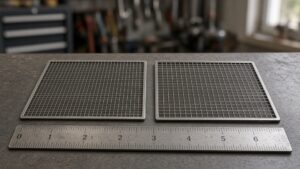
When we install ember-resistant vents at Ember Pro USA, we use products with 1/16-inch (or finer) corrosion-resistant metal mesh. This is a critical specification. The difference between 1/4-inch and 1/16-inch mesh is dramatic:
- Ember protection: The fine mesh blocks burning embers and firebrands from entering your attic, crawl space, and wall cavities. While no vent is 100% ember-proof (they still need to allow airflow), 1/16-inch mesh drastically reduces the size and quantity of burning material that can pass through.
- Rodent exclusion: Rats and mice cannot fit through 1/16-inch openings. Period. Standard pest control companies often recommend 1/4-inch hardware cloth for rodent exclusion — but that’s the same size as your current vent screens that are already failing. Our 1/16-inch mesh goes far beyond that threshold.
- Insect barrier: Wasps, yellowjackets, paper wasps, mud daubers, cockroaches, and most other common San Diego pests cannot pass through 1/16-inch mesh. This is especially important for attic vents and soffit vents, which are prime nesting spots for stinging insects.
- Bird exclusion: Birds nesting in vents is a common complaint from homeowners. Fine mesh eliminates this problem entirely.
The material matters too. We use galvanized steel, stainless steel, or aluminum mesh — not fiberglass or plastic. These metals resist corrosion in our coastal San Diego climate, they won’t melt or ignite during a fire, and they’re strong enough that rodents can’t chew through them. Standard fiberglass window screen? Rats go through that in about 30 seconds.
Not sure which step to prioritize first? Our wildfire risk calculator shows your CAL FIRE zone and exposure level — so you know exactly where to start.
Common San Diego Pests That Enter Through Vents
If you live anywhere in Southern California, you’re dealing with pest pressure year-round. Our mild climate means there’s no real “off season” for most pests. Here are the ones we hear about most from homeowners:
Rats and Mice
Roof rats are the number one pest complaint in San Diego County. According to the San Diego County Department of Environmental Health, roof rats are excellent climbers and frequently enter homes through attic vents, soffit gaps, and damaged vent screens. Once inside, they contaminate insulation with urine and droppings, chew electrical wiring (a fire hazard in itself), and breed rapidly. A single pair of rats can produce dozens of offspring in a year.
Mice need even less space. A house mouse can squeeze through an opening the size of a dime. Standard 1/4-inch vent mesh might as well be an open door.
Wasps, Yellowjackets, and Bees
Attic vents and soffit vents are prime real estate for paper wasps, yellowjackets, and occasionally honey bees looking for a cavity to build in. Once a colony establishes itself in your attic or wall void, removal is expensive and disruptive. Preventing access in the first place is far simpler and cheaper.
Cockroaches
American cockroaches (the large ones San Diegans sometimes call “waterbugs”) are strong fliers and commonly enter through attic and foundation vents. Oriental cockroaches prefer damp crawl spaces and use foundation vents as entry points. Both species easily pass through 1/4-inch mesh.
Birds
Starlings, sparrows, and other cavity-nesting birds will exploit damaged or poorly screened vents to build nests in attics and dryer vents. Bird nests in vents create fire hazards, block airflow, and introduce mites and other parasites into your home.
Other Invaders
Depending on your location, you might also deal with squirrels, possums, or raccoons testing your vent screens. While larger animals may not fit through even standard mesh, they can easily damage flimsy fiberglass or plastic screens to create an opening — something they can’t do with heavy-gauge metal ember-resistant screens.
Wondering if your property is in a high-risk fire zone? Check your wildfire risk score to see your CAL FIRE zone and exposure level based on your address.
Why This Dual Benefit Matters for Your Budget
Let me put this in practical terms. I’ve talked to homeowners who are paying $300-$500 per year for ongoing pest control services — treatments, traps, exclusion repairs, attic cleanouts after rodent infestations. Some have spent thousands on removing wasp nests from wall cavities or cleaning up after rats have destroyed attic insulation.
Meanwhile, the cost of upgrading to ember-resistant vents is a one-time investment. You’re not paying monthly or quarterly. You install them once, and they protect your home from both fire and pests for decades.
Think about it this way: even if you never face a wildfire (and living in Southern California, the odds say you will at some point), the pest exclusion benefit alone delivers ongoing value. You’re reducing your dependence on chemical pest treatments, lowering the risk of rodent-caused electrical fires, and eliminating the conditions that lead to expensive attic remediation.
And if a wildfire does threaten your home, those same vents could be the difference between your house standing and your house burning. That’s a return on investment that’s hard to argue with.
What a Vent Upgrade Looks Like
At Ember Pro USA (CSLB License #1142407), our process is straightforward. We start with a free 10-point wildfire home inspection where we assess every vent on your home — attic, soffit, foundation, gable, ridge, and dryer vents. We identify which ones are vulnerable, which mesh type is currently installed, and what the best replacement options are for your specific home.
From there, we provide a clear quote for upgrading your vents to ember-resistant models that meet or exceed current California building code requirements. Our installations use products that have been tested and rated for ember and flame resistance, and we ensure proper airflow is maintained. Adequate ventilation is essential for preventing moisture buildup and keeping your attic and crawl space healthy — we never sacrifice airflow for protection.
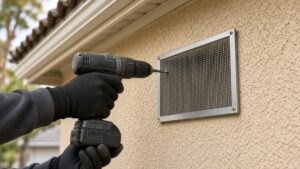
The installation itself is typically completed in a day for most homes. There’s no major construction involved. We remove your old vent covers, install the new ember-resistant units, and seal any gaps around the perimeter. When we’re done, you have a vent system that blocks embers, blocks pests, resists corrosion, and still allows proper ventilation.
The Bigger Picture: Home Hardening
Vent upgrades are one piece of a comprehensive home hardening strategy. At Ember Pro USA, we approach wildfire defense holistically. Vents, eaves, siding, decking, fencing, landscaping — every component of your home’s exterior plays a role in whether your property survives a wildfire.
But vents are where we often recommend homeowners start, for a few reasons:
- They’re one of the most cost-effective upgrades
- Installation is quick and minimally disruptive
- The ember protection impact is significant — vents are a primary ignition pathway
- You get the immediate bonus of pest exclusion
- Many insurance companies recognize vent upgrades as a meaningful risk reduction
If you’re in San Diego, Los Angeles, Orange County, or Riverside County and you’re thinking about wildfire preparedness, vents are a smart place to begin. And now you know you’re getting double the benefit.
Don’t Wait for Fire Season
Here’s my advice: don’t wait until you see smoke on the horizon to think about your vents. And don’t wait until you hear scratching in your attic at 2 AM to think about pest exclusion. One upgrade handles both problems, and the best time to do it is before you need it.
Give us a call at (858) 939-9345 in San Diego or (310) 499-4891 in Los Angeles. Or contact us online to schedule a conversation. We’re happy to answer questions, walk through your options, and help you figure out the right approach for your home.
You can also start with our free 10-point wildfire home inspection — we’ll evaluate your vents along with every other vulnerability on your property, and give you a prioritized list of recommendations. No pressure, no obligation. Just honest guidance from people who do this every day.
Stay safe out there.
— Jim Sprouse, CEO & Co-Founder, Ember Pro USA
CSLB License #1142407
Serving San Diego, Los Angeles, Orange County, and Riverside County
Frequently Asked Questions
Do ember-resistant vents also keep out pests?
Yes. Ember-resistant vents use 1/16-inch or finer metal mesh that blocks rats, mice, wasps, cockroaches, birds, and most other common household pests. Standard vent screens use 1/4-inch mesh, which is large enough for rodents and insects to pass through. Upgrading to ember-resistant vents gives you wildfire protection and pest exclusion in a single installation.
What size mesh keeps rats and mice out of attic vents?
Mice can fit through openings as small as 1/4 inch, so standard vent screens offer no protection. A 1/16-inch mesh — the same size used in ember-resistant vents — is small enough to block all rodents, including juvenile mice. The mesh should be made from galvanized steel, stainless steel, or aluminum so rodents cannot chew through it.
Will ember-resistant vents reduce airflow in my attic?
Properly designed and installed ember-resistant vents maintain adequate airflow for attic and crawl space ventilation. The finer mesh does create slightly more resistance than standard screens, which is why it’s important to use vents engineered specifically for this purpose rather than simply adding mesh over existing vents. Professional installation ensures your home meets ventilation requirements while maximizing protection.
How much does it cost to upgrade to ember-resistant vents?
The cost varies depending on the number and type of vents your home has, but vent upgrades are one of the most affordable home hardening measures. For many homeowners, the one-time cost is comparable to one or two years of quarterly pest control services — and the vents last for decades. Ember Pro USA offers free 10-point wildfire home inspections that include a vent assessment and clear pricing.
Do I need to replace all my vents or can I retrofit them?
In some cases, fine metal mesh can be added over existing vent openings as a retrofit. However, full replacement with purpose-built ember-resistant vents provides better protection because these units are engineered for both ember and flame resistance, not just ember screening. During a free inspection, we evaluate each vent and recommend the most effective and cost-efficient approach for your specific home.
What types of vents on my home are most vulnerable to embers and pests?
Attic gable vents, soffit vents, foundation vents, and ridge vents are the most common entry points for both embers and pests. Dryer vents with damaged or missing flaps are also vulnerable. Any vent with standard 1/4-inch mesh, damaged screens, or gaps around the frame should be prioritized for upgrade.
Are ember-resistant vents required by California building code?
California Building Code Chapter 7A requires ember-resistant vents for new construction and certain remodels in designated Wildland-Urban Interface (WUI) areas. Even if your home isn’t in a WUI zone, upgrading is strongly recommended — embers can travel over a mile and threaten homes well outside fire perimeters. Many insurance companies also offer benefits for homes with ember-resistant vent upgrades.
Does Ember Pro USA serve areas outside San Diego?
Yes. Ember Pro USA serves San Diego, Los Angeles, Orange County, and Riverside County. Call (858) 939-9345 for San Diego or (310) 499-4891 for Los Angeles, or visit our website to schedule a free 10-point wildfire home inspection.
Curious about your property’s actual wildfire risk? Our free calculator shows your CAL FIRE zone, exposure level, and recommended next steps based on your address.
Get your free risk score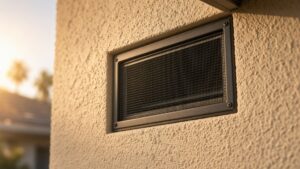
Leave a Reply